How to Figure Out Your Skin Type for Korean Skincare
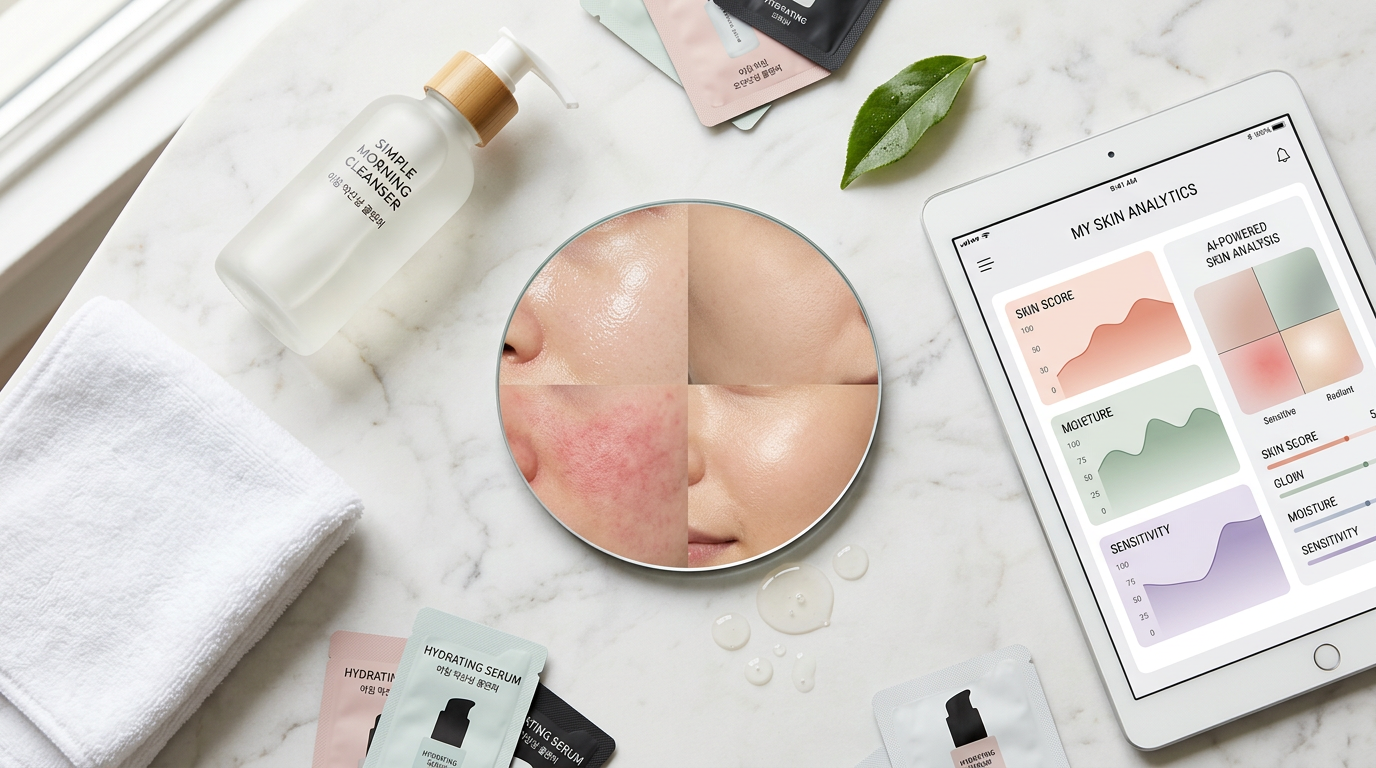
Most people get their skin type wrong, and that's why their K-beauty routine isn't working. Here's how to actually diagnose your skin's needs before you spend another dollar on products that weren't meant for you.
How to Figure Out Your Skin Type for Korean Skincare
Quick Answer
Question: How do I determine my actual skin type so I can pick the right Korean skincare products?
Answer: The most reliable at-home method is the bare-face test: cleanse with a gentle, low-pH cleanser, pat dry, and wait 90 minutes without applying anything. Then check how your skin feels and looks across your forehead, nose, cheeks, and chin. Oily skin will feel slick pretty much everywhere. Dry skin will feel tight and may show flaking. Combination skin will show oil concentrated in the T-zone with dryness or normalcy on the cheeks. Sensitive skin will likely react to even the gentle cleanser with redness, stinging, or blotchiness. But your skin type is only half the picture. You also need to understand your skin's current condition, things like dehydration, barrier damage, or hormonal fluctuation, because that's what determines which Korean ingredients and product textures will actually help rather than make things worse.
The Situation You're In
I want you to think about the last Korean skincare product you bought. Not why you bought it, but how you chose it. Was it a TikTok video where someone with perfect skin held up a bottle and said "this changed my life"? A Reddit thread where 400 people swore by a particular snail mucin essence? Maybe a friend's recommendation, or an impulse buy because the packaging was gorgeous and the price felt like a steal?
Now think about what happened after you started using it. If you're reading this article, I'm guessing it didn't go the way you hoped.
Maybe your skin broke out along your jawline two weeks in. Maybe your cheeks started feeling papery and tight even though you were moisturizing twice a day. Or maybe nothing dramatic happened, but nothing improved either, and you're sitting there with a bathroom shelf full of half-used products wondering what you're doing wrong.
You're not doing anything wrong, exactly. You're just missing one critical piece of information that should come before everything else, and weirdly, almost nobody takes the time to figure it out properly. You need to know what your skin actually is right now. Not what it was in high school, not what some online quiz told you three years ago, and not what you've assumed based on one season of the year.
Here's a simple thing you can do in the next two hours: wash your face with whatever gentle cleanser you have, pat it dry with a clean towel, and then don't touch it. Don't apply toner, serum, moisturizer, nothing. Set a timer for 90 minutes and go do something else. When the timer goes off, grab a clean tissue and gently press it against your forehead, your nose, and each cheek separately. What shows up on that tissue, combined with how your skin feels, will tell you more about your skin type than any product recommendation algorithm.
I'll walk you through exactly how to read those results below, along with some mistakes I see people make constantly when they try to self-diagnose.
Why This Happens
Skin type confusion is probably the single most expensive problem in Korean skincare. Not because the products are bad, but because even a brilliant product becomes the wrong product when it's matched to the wrong skin.
And the confusion makes sense when you think about it. The beauty industry has been handing us the same four categories for decades: oily, dry, combination, sensitive. Those categories aren't useless, but they're incomplete in a way that causes real problems. Your skin can be oily on the surface and dehydrated underneath at the same time. You can develop what looks and feels like sensitivity when the real issue is a compromised moisture barrier from over-exfoliating. Your hormonal cycle can make your skin behave completely differently in week one versus week three of your period. Even the city you live in matters. Someone in Phoenix, Arizona and someone in Seattle, Washington could have the same genetic skin type but need totally different routines because of humidity differences alone.
Where this really spirals is when you start building a multi-step Korean routine based on the wrong diagnosis. Say you think you're oily because your forehead gets shiny by lunchtime. So you reach for mattifying toners, lightweight gel moisturizers, and maybe a clay mask twice a week. But what if your skin is actually dehydrated and producing excess oil to compensate for a lack of water in the skin? Those mattifying products strip what little moisture you have left, your skin panics and produces even more sebum, and you end up in this frustrating cycle where the "right" products keep making things worse. I've seen this pattern so many times.
The reverse happens too. If you assume you're dry and load up on rich, occlusive creams when your real issue is a damaged barrier, you might be trapping irritants against your skin under a heavy layer of product. The redness doesn't go away. The texture gets worse. And you blame the cream when the actual problem started three steps earlier in your routine.
Social media makes all of this harder because it collapses context. When a product goes viral on TikTok, you see the result but almost none of the variables. That creator probably has different skin than you, lives in a different climate, has a different diet, different stress levels, and is at a different point in their hormonal cycle. The product might be genuinely excellent, but without understanding your own skin's baseline, buying it is basically a coin flip. And when your routine has seven or eight steps, that's a lot of coin flips.
There's one more thing that rarely gets talked about. Your skin type isn't fixed for life. It shifts with age, with seasons, with medications, with stress, even with big dietary changes. The skin type you identified five years ago might not be your skin type today. So even if you did the work once, it's worth revisiting, especially if your routine has stopped working and you can't figure out why.
What Actually Works
1. Do the bare-face test properly and actually write down what you find
I mentioned this above, but let me walk through it step by step because most people either skip it or do it too casually to get useful information.
First, pick a day when your skin is relatively "normal," meaning you haven't just tried a new product, you're not in the middle of a breakout from something you ate, and you haven't been in unusual weather. Wash your face with a gentle, low-pH cleanser. If you're not sure about your cleanser's pH, the COSRX Low pH Good Morning Gel Cleanser is a safe bet and easy to find. Pat dry with a clean towel. Don't rub.
Now set a timer for 90 minutes. This is longer than the 30 minutes some guides recommend, and that's intentional. At 30 minutes, your skin is still adjusting. By 90 minutes, it's settled into its natural state.
During that time, don't touch your face. Don't sit in front of a fan or heater. Just go about your day normally.
When the timer goes off, do three things:
Look at your skin in natural light (not bathroom lighting, which tends to wash everything out). Check for shine, flaking, redness, or visible pores.
Touch your skin gently. Does it feel slick? Tight? Rough in some areas and smooth in others? Does pressing on your cheek leave a temporary indentation or does it bounce right back?
Blot with a clean tissue, pressing gently on your forehead, nose, left cheek, and right cheek separately. Check each section of the tissue for oil transfer.
Now write this down. Seriously. Open the notes app on your phone and record what you observed for each zone of your face. This matters because you're going to want to compare this to what your skin does in a different season, or after you adjust your routine, and memory is unreliable for this kind of subtle detail.
Here's how to interpret what you found:
- Oil on all four zones, skin feels comfortable or slightly slick: Likely oily skin type. You'll do well with lightweight, water-based Korean products and ingredients like niacinamide, green tea, and BHA.
- No oil anywhere, skin feels tight or looks dull/flaky: Likely dry skin type. Look for ceramides, hyaluronic acid layered under an occlusive, and richer cream textures.
- Oil on forehead and nose, little to none on cheeks: Classic combination. This is the most common result, and it means you probably need different products (or at least different amounts) for different zones of your face.
- Redness, stinging, or irritation even from the gentle cleanser: Your skin is reactive, whether that's inherent sensitivity or a damaged barrier. Centella asiatica, madecassoside, and minimal-ingredient formulas are your friends. Avoid fragrance, essential oils, and high-concentration actives until your barrier recovers.
- Skin feels tight AND looks oily after 90 minutes: This is the tricky one. You're probably dealing with dehydrated skin, which is a condition, not a type. Your skin is producing oil because it's lacking water. You need hydrating layers (think multiple light layers of hydrating toner, sometimes called the "7 skin method" in Korean skincare) rather than heavy creams.
2. Check your skin type more than once
One test gives you a snapshot. Your skin in January is not your skin in July. If you live somewhere with real seasons, I'd suggest doing the bare-face test at least twice a year, once in the colder months and once when it's warm and humid. You might find you're combination in summer but genuinely dry in winter, which means your routine should shift accordingly.
Hormonal cycles matter too. If you menstruate, your skin in the follicular phase (roughly days 1 through 14) tends to behave differently than in the luteal phase (days 15 through 28). Some people find they get oilier and more breakout-prone in the week before their period. Doing the bare-face test at different points in your cycle can reveal patterns that explain why your skin seems unpredictable.
Keep notes on all of this. It sounds like a lot, but even a few bullet points each time will build a picture that's genuinely useful.
3. Learn to separate skin type from skin condition
This distinction is maybe the most important thing in this entire article, and it's something the Korean skincare community understands better than most Western beauty culture.
Your skin type is largely genetic. It's about how much sebum your skin naturally produces. You can't really change it.
Your skin condition is what's happening right now because of environmental factors, product choices, stress, diet, hydration levels, sleep quality, and hormonal fluctuations. Conditions include dehydration, sensitivity from barrier damage, hyperpigmentation, congestion, and dullness.
Most skincare mistakes happen when people treat a condition as if it were their type. For example, if your skin is dehydrated (condition) and producing excess oil as a result, treating it as oily (type) will make things worse. If your barrier is damaged from over-exfoliation (condition) and your skin is red and reactive, treating it as inherently sensitive (type) might lead you to avoid beneficial ingredients your skin actually needs once it heals.
When you do the bare-face test, try to distinguish between what seems like your baseline tendency and what might be a temporary condition layered on top. If you've recently started a new active ingredient, switched climates, or been under unusual stress, your results might reflect the condition more than the type. That's still useful information, because your current condition determines what your skin needs right now, but keep in mind it may not be permanent.
4. Match ingredients to your findings, not to hype
Once you have a clear picture of your skin type and current condition, you can start making much smarter choices about Korean skincare products. And this is where things get exciting, because Korean formulations tend to be incredibly specific in what they target. Seoul Sister's Ingredient Encyclopedia covers 8,200+ ingredients with safety ratings, effectiveness by skin type, and comedogenic scores, so you can research any ingredient before committing to a product.
For oily skin types, look for:
- Niacinamide (oil regulation, pore refinement)
- BHA/salicylic acid (clears inside pores)
- Green tea extract (antioxidant, lightly mattifying)
- Lightweight gel or water-cream textures
For dry skin types, look for:
- Ceramides (restore and strengthen the moisture barrier)
- Squalane (mimics natural skin oils)
- Hyaluronic acid (but layer it under something occlusive, or it can actually pull moisture from your skin in dry climates)
- Shea butter or richer cream textures, especially at night
For combination skin, the honest answer is that you'll probably benefit from a flexible approach. Use lighter, hydrating products all over and add richer products only where you're dry. A lot of Korean skincare routines are actually built for this kind of zone-specific application, even if nobody explicitly says so.
For dehydrated skin (regardless of type), focus on:
- Multiple thin layers of hydrating toner (the "7 skin method" or a simplified version of it)
- Hyaluronic acid serums applied to damp skin
- A good moisturizer to seal hydration in
- Cutting back on actives, especially AHA, BHA, and retinol, until your hydration levels recover
For barrier-damaged or reactive skin:
- Centella asiatica and its derivatives (madecassoside, asiaticoside)
- Panthenol (vitamin B5)
- Minimal ingredient lists, ideally under 20 ingredients
- No fragrance, no essential oils, no alcohol (denat.) high on the ingredient list
- Gentle, milky or balm cleansers instead of foaming ones
5. Stop building your routine from someone else's blueprint
This is the hard one because K-beauty culture, especially on social media, is built around sharing routines. And there's nothing wrong with getting inspiration from someone else's routine. The problem is when you copy it wholesale without adjusting for your own skin.
A 10-step routine isn't inherently good or bad. For some skin types and conditions, 10 thoughtfully chosen steps can produce incredible results. For others, it's seven too many products and a recipe for congestion and irritation. Your bare-face test results should guide how many steps you actually need and what each step should accomplish.
If your skin is oily and relatively healthy, you might only need a cleanser, a lightweight hydrating toner, a niacinamide serum, a gel moisturizer, and sunscreen. That's five steps and it's plenty. If your skin is dry with some hyperpigmentation, you might want a double cleanse, a hydrating toner, an essence, a vitamin C serum, a ceramide cream, and sunscreen, which is six steps with each one serving a clear purpose.
The question to ask about every product in your routine is: "What is this doing for my skin specifically?" If you can't answer that clearly, it probably doesn't need to be there. If you want help evaluating your current lineup, list your products to Yuri right here on this page; she's free, needs no signup, and can talk through gaps, redundancies, and how well your products work together.
Where Seoul Sister Fits In
One of the biggest frustrations I hear from people getting into Korean skincare is that even after they figure out their skin type, they don't know how to evaluate the actual products. And that's a reasonable frustration.
Most K-beauty products have ingredient lists in Korean, so unless you read Korean, you're relying on whatever the English-language retailer decides to translate or highlight. You can't easily verify whether a product sold on a third-party site is authentic or a counterfeit. You see a product that costs $12 in Korea selling for $35 in the US and have no idea if that markup is normal or absurd. And once you buy something, there's no easy way to track when it expires, even though Korean products have PAO (Period After Opening) dates that most people don't know how to read.
Seoul Sister was built to solve exactly these problems. The Ingredient Encyclopedia helps you match products to your skin type and condition with confidence, and the product database gives you pricing transparency across the retailers we track (led by Olive Young, with Soko Glam and iHerb where available) so you're not overpaying for something that might not even be the right fit.
If you'd rather talk through your results with someone, Yuri is Seoul Sister's AI skincare advisor, free to chat with right here on this page, no account needed. You can describe your bare-face test results, your concerns, and your current products, and she'll help you build a routine matched to your actual skin type and condition, not what's trending this week. She can also flag ingredient conflicts if you're layering multiple products, which matters most for combination and sensitive skin.
What to Do Right Now
You don't need to overhaul everything at once. Start with the bare-face test tonight or tomorrow morning. Write down your results. Compare them to the descriptions above and see where you land. If the results surprise you, that's actually a good sign because it means you're about to stop wasting money on products that were never right for your skin in the first place.
Then take a hard look at your current routine. Does every product match what your skin is actually asking for? Are there steps you included because someone else recommended them rather than because your skin needs them? Are you using any actives that might be compromising your barrier without you realizing it?
Figuring out your skin type isn't glamorous. Nobody's making viral content about pressing a tissue to their forehead and waiting 90 minutes. But it's the single most useful thing you can do before spending another dollar on Korean skincare.