Why Is Korean Skincare So Cheap? The Real Reason a $12 Serum Outperforms a $60 One
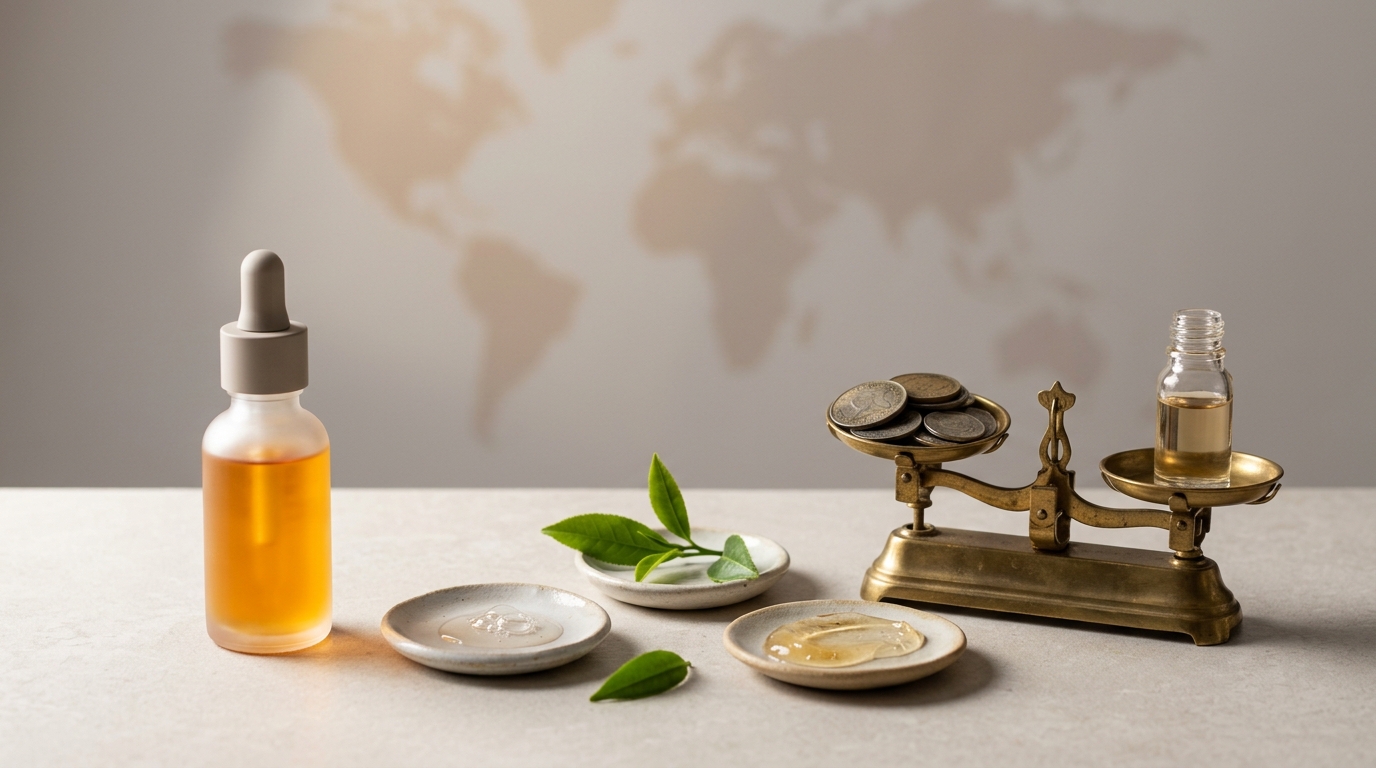
That $11 Korean cleanser outperforming your $38 one is not hiding anything. The low price comes from how the Korean beauty industry is built, not from what is in the bottle. With one geographic catch.
The Question Behind the Question
You picked up a Korean cleanser for eleven dollars. It has a longer, better-formulated ingredient list than the thirty-eight dollar one you were using, the texture is nicer, and your skin likes it more. So you did what anyone would do and got suspicious.
Cheap usually means something. Cheaper ingredients, filler formulas, a cut corner somewhere you cannot see yet. That instinct is healthy and it is why you are reading this instead of just adding four more things to your cart.
Here is the short version: the price is not hiding anything. Korean skincare is genuinely inexpensive at home, and the reasons are structural, boring, and entirely about how the Korean beauty industry is built rather than what is inside the bottle.
There is a catch, but it is not the one you are bracing for. The catch is geographic, and we will get to it.
Quick Answer
Question: Why is Korean skincare so cheap compared to Western brands?
Answer: Four structural reasons, none of them about formula quality. Korea has an unusually dense domestic market where hundreds of brands compete for the same shelf space, which makes overpricing a near identical formula commercially impossible. Most Korean brands do not own factories; they develop through large contract manufacturers such as Cosmax and Kolmar, who serve hundreds of brands and carry the R&D and production infrastructure that a Western brand would have to fund alone. Distribution is short, often brand to retailer to customer, with fewer margin layers than the Western model. And Korean beauty marketing is weighted toward e-commerce, creators, and retail placement rather than the expensive campaigns priced into legacy Western brands. The important qualifier: this is why K-beauty is cheap in Korea. By the time the same product reaches a US shelf it has usually passed through importers and distributors who add their own margins, which is a separate story we cover in our companion piece on US pricing.
Reason One: The Shelf Is Impossibly Crowded
Korean beauty retail is concentrated to a degree that has no real Western equivalent. Olive Young operates roughly 1,380 stores domestically and posted 2025 revenue of about 5.83 trillion won, and it is the gatekeeper most domestic brands need to reach shoppers at scale.
That concentration produces relentless price discipline. When a shopper can compare six competing hyaluronic acid serums in one aisle, and several of those formulas are genuinely comparable, no brand can hold a premium on the formula alone. A brand that prices twenty percent above a near identical competitor does not get a slow decline in sales. It gets skipped.
Western beauty pricing does not face the same pressure, because Western shoppers are usually choosing between brands that sit in different stores, different price tiers, and different marketing universes.
Reason Two: Most Brands Do Not Own a Factory
This is the piece most people miss, and it is the one that actually explains the ingredient lists.
A large share of Korean brands are developed through contract manufacturers. Cosmax and Kolmar Korea are the two dominant names. Cosmax manufactures for over 600 brands worldwide, and fifteen of the world's twenty largest cosmetics companies have entrusted manufacturing to it. Kolmar commits around seven percent of sales to research and development, with researchers making up at least thirty percent of its workforce.
Read that again with your shopping in mind. The formulation science behind an inexpensive Korean serum may come from the same laboratories that develop products for global luxury houses. The brand did not need to build a lab, hire a formulation team, or run its own production line. It licensed access to infrastructure that already existed.
That is why a twelve dollar Korean serum can carry an ingredient list that embarrasses a sixty dollar Western one. You are not paying for the R&D building, because the brand did not have to buy it either.
One honest caveat, because it complicates the neat version of this story: the top tier manufacturers are not automatically the cheap option. Cosmax and Kolmar carry higher minimum order quantities and higher unit prices than smaller factories, precisely because they are in demand. The savings come from shared infrastructure across many brands, not from cut rate production.
Reason Three: Fewer Hands Between the Lab and You
In Korea, the path from brand to customer is short. A brand sells through its own channel or through a domestic retailer, and that is often the whole chain.
The traditional Western model adds layers. A brand sells to a distributor, the distributor sells to a retailer, and each one takes a margin sized to cover inventory risk, warehousing, and returns. Every layer is a legitimate business doing real work, and every layer raises the shelf price of a product whose manufacturing cost never changed.
Fewer layers, lower final price, same bottle.
Reason Four: The Marketing Budget Is Not in the Bottle
Korean beauty grew up alongside e-commerce, beauty creators, and reviews. A lot of Korean brands became well known through organic momentum and retail placement rather than through the sustained advertising spend that legacy Western brands treat as a fixed cost.
Advertising is a real expense and it is priced into what you pay. When a brand spends less to be discovered, the product can carry a lower price without touching the formula.
The Catch: It Is Cheap in Korea
Everything above describes the Korean domestic market. Whether it stays cheap depends entirely on how the product reaches you.
Buy the same item from a US retailer and it may have passed through an importer, a distributor, and a retailer, each adding margin, plus freight and customs handling. That is a different set of economics with a different answer, and we wrote it up separately in Why Is K-Beauty So Expensive in the US?.
Both things are true at once. K-beauty is inexpensive at source and can be unremarkable value by the time it reaches a US shelf. Holding both ideas together is most of what it takes to shop this category well.
So Is Cheap Ever a Warning Sign?
Sometimes, though rarely for the reason people fear. Three situations genuinely deserve a second look.
A price far below every other seller of the same product. Counterfeits are a real problem in this category, particularly for viral products sold through third party marketplace listings. If one seller is dramatically under everyone else on a popular item, that gap is the thing to question. Our five point authenticity check walks through how to tell.
Deep discounts near end of shelf life. Korean products print a manufacturing date, not only an expiry, plus a period after opening symbol. A discount on something you cannot finish in time is not a saving.
A formula that is cheap because it is thin. This is uncommon but it exists. The fix is the ingredient list, not the price tag.
What is almost never true is that a low price by itself signals a bad formula. In this market, low prices are what competition looks like.
How We Check This
Seoul Sister maintains a catalog of 6,105 Korean beauty products across 565 brands, with full ingredient lists recorded for 5,823 of them, queried on August 19 2026. We built it because comparing what is actually inside two products is the only reliable way to tell whether a price difference reflects a formula difference.
That is also the honest limit of what we can tell you here. Our catalog is strongest on ingredients and product records. We deliberately are not publishing a Korea versus US price table in this article, because our own retailer price data is not yet clean enough per product to support one, and a table that looks precise while being wrong is worse than no table. When it is solid, we will publish it.
In the meantime, the useful move is comparing formulas rather than prices. Yuri, our AI skincare advisor, can look at a product you are considering and tell you whether a cheaper one with a comparable ingredient profile would do the same job for your skin. She is free to use right here on this page, no account needed, and she has no reason to talk you into a purchase.
Frequently Asked Questions
Is Korean skincare cheap because the ingredients are lower quality?
No. The low prices come from market structure rather than formulation shortcuts. Intense domestic competition, shared manufacturing infrastructure through large contract manufacturers, short distribution chains, and lower marketing overhead all push the final price down without changing what goes in the bottle. Many inexpensive Korean products are developed at the same contract manufacturers that produce for global luxury brands.
Why is Korean skincare cheaper than American skincare?
The biggest differences are distribution and marketing. American brands often sell through a distributor and then a retailer, with each adding margin, and legacy brands carry substantial advertising costs in their pricing. Korean brands more often sell direct or through a single dominant domestic retailer, and grew largely through creators and reviews. Manufacturing scale through contract manufacturers also spreads R&D cost across many brands rather than one.
If it is so cheap in Korea, why did I pay a lot for it in the US?
Because the price you paid reflects the import chain rather than the Korean retail price. Freight, customs handling, distributor margin, and US retailer margin all stack on top of the original price. Our companion article on US K-beauty pricing breaks down where each layer goes.
Does a cheap Korean product mean it is fake?
Not on its own. Low prices are normal in this category. What is worth questioning is a price far below every other seller of the same item, which is a common counterfeit signal, especially on viral products from third party marketplace sellers. Check the manufacturing date, confirm the seller is authorized by the brand, and compare packaging against the brand's Korean site.
Are Korean products sold in the US the same formula as in Korea?
Usually, but not always. Some products are reformulated for the US market because certain UV filters approved in Korea are not approved by the FDA, which particularly affects sunscreens. If formulation matters to you, compare the ingredient lists rather than assuming the SKU is identical.