Best Korean Skincare for Dry Skin With Pigmentation: A Routine That Treats Both
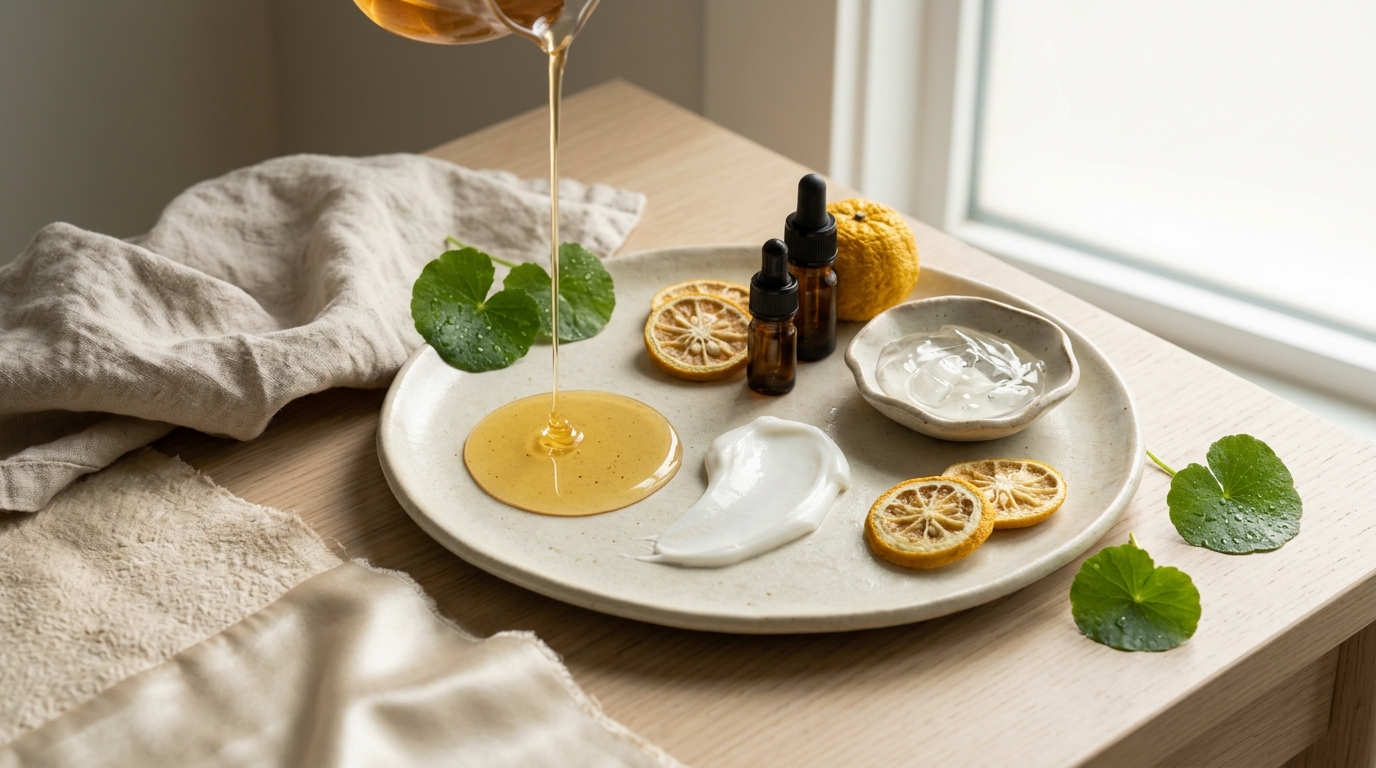
Treating pigmentation when your skin is dry feels like a catch-22. Most brightening actives are harsh, and most hydrating routines ignore dark spots entirely. Here's how to build a K-beauty routine that does both without compromise.
Best Korean Skincare for Dry Skin With Pigmentation: A Routine That Treats Both
Quick Answer
Question: What's the best Korean skincare approach for someone with both dry skin and pigmentation?
Answer: You need gentle, stable vitamin C derivatives paired with barrier-supporting ingredients like ceramides and hyaluronic acid. K-beauty is genuinely great for this because so many Korean formulas are built to brighten without wrecking your moisture barrier, using lower-irritation actives at concentrations that actually work over time. The most important thing to get right is your routine order: hydration and barrier repair come first, and brightening actives go on top of skin that's already protected. Skip this step and you'll end up more irritated, more pigmented, and more frustrated than when you started.
That Cycle You're Stuck In
I want to describe something and tell me if it sounds familiar. You notice dark spots forming along your cheekbones or around your mouth, maybe from old acne marks, maybe from sun exposure you didn't think was that bad. So you do what anyone would do: you search "best serum for dark spots," find a highly rated vitamin C with gorgeous packaging and 47,000 TikTok views, and you start using it every morning. If those spots are mostly old acne marks rather than sun damage, our guide to Korean skincare for PIH and post-acne dark spots covers that case in more detail.
Three days later, your skin is screaming. The dry patches on your cheeks, the ones that were already tight and flakey before, are now raw and angry. Your forehead is peeling. And the dark spots? If anything, they look worse against all that redness and irritation.
So you panic and swing the other direction. You ditch every active in your routine, pile on the heaviest moisturizer you can find, and just focus on calming everything down. Your skin stops hurting, which is a relief. But those dark spots? They're still there. Months go by and they're just... Still there, staring back at you in every mirror and every front-facing camera.
This back-and-forth between "treat the pigmentation" and "protect the barrier" is exhausting, and if you've been living in it, I want you to know it's not because you're doing something wrong. It's because most skincare advice treats these as two separate problems with two separate solutions, when they're actually deeply connected. And Korean skincare is one of the few approaches that was designed from the ground up to handle exactly this kind of overlap.
Why Dry Skin and Pigmentation Make Each Other Worse
This is the part nobody explains well enough, and I think understanding the mechanism is what finally makes the right routine click.
Most ingredients that target hyperpigmentation are inherently aggressive. Pure L-ascorbic acid needs a pH around 3.5 to penetrate effectively, which is acidic enough to sting healthy skin, let alone skin that's already dry and compromised. Retinoids speed up cell turnover to push pigmented cells to the surface faster, but that same accelerated turnover thins the outer protective layer that dry skin is already lacking. AHAs like glycolic acid dissolve the bonds between dead skin cells, which sounds great for dullness and uneven tone until you realize it's also dissolving what little barrier function you have left.
And here's where it gets genuinely cruel. When your barrier is damaged from all that aggressive treatment, your skin becomes more prone to post-inflammatory hyperpigmentation, not less. Irritation triggers inflammation. Inflammation signals your melanocytes to produce more melanin as a protective response. So the very ingredients you're using to fade dark spots can actually create new ones if your barrier isn't intact when you apply them. I've seen this happen to people over and over, and it's one of the most demoralizing cycles in skincare because you feel like you're doing everything right and still losing ground.
The Western approach to pigmentation tends to be "find the strongest active at the highest concentration your skin can tolerate." For some people with oily, resilient skin, that works fine. But if you're dry, that philosophy will wreck you.
Korean skincare takes a fundamentally different approach. Instead of one aggressive ingredient doing all the heavy lifting, K-beauty formulations tend to use gentler derivatives of proven actives at moderate concentrations, layered between hydrating and barrier-repairing steps. Results build more gradually, usually over 6 to 12 weeks instead of 2, but they actually hold because you haven't compromised the foundation of your skin to get them. It's a slower path, but it's the one that doesn't collapse on itself.
What Actually Works: A Step-by-Step Approach
1. Replace Pure Vitamin C With a Stable, Gentle Derivative
You don't have to give up vitamin C entirely. You just need a form of it that won't torch your barrier.
Sodium ascorbyl phosphate (SAP) is a water-soluble vitamin C derivative that converts to active ascorbic acid inside your skin after you apply it. The big difference is that SAP works at a neutral pH around 7, so it doesn't create that stinging, acidic environment that makes dry skin spiral. It still inhibits tyrosinase, the enzyme that drives melanin production, and it still provides antioxidant protection against UV-triggered pigmentation. You just don't pay for those benefits with irritation.
Another option worth knowing about is ascorbyl glucoside, which is even more stable and shows up in a lot of Korean essences and ampoules. It's slower-acting than SAP but extremely well-tolerated, and for very dry or sensitive skin, that tradeoff is often worth it.
How to find the right product: This is where things get tricky if you're shopping for K-beauty online, because ingredient lists on Korean products are often in Korean only. Seoul Sister's product database lets you search by specific ingredients across 5,800+ Korean skincare products, so you can filter for SAP or ascorbyl glucoside and immediately see which products contain them, at what position in the ingredient list (which gives you a rough sense of concentration), and whether there are any conflicting ingredients in the same formula.
2. Build Your Barrier Before You Brighten
This is the step most people skip because it feels like you're "not doing anything" about the pigmentation. But spending 2 to 4 weeks focused purely on barrier repair before introducing any brightening actives will dramatically improve how well those actives work and how well your skin tolerates them.
What barrier repair actually looks like in practice:
- Ceramides are non-negotiable. Ceramide AS, ceramide NP, and ceramide AP are the ones most closely matched to the ceramides naturally present in human skin. You want a moisturizer or cream that lists at least one of these in the first half of its ingredient list.
- Hyaluronic acid in multiple molecular weights helps with both surface hydration and deeper moisture retention. Hydrolyzed sodium hyaluronate is a lower-molecular-weight form that penetrates better than standard hyaluronic acid, and a lot of Korean toners and essences use it as a base.
- Panthenol (vitamin B5) at 2 to 5% concentration reduces transepidermal water loss and calms irritation. It shows up in a surprising number of Korean products, and it plays well with almost everything.
A simple barrier-repair phase routine looks like: gentle low-pH cleanser, hydrating toner with hyaluronic acid, a panthenol-containing serum or essence, and a ceramide-rich cream. That's it. No actives, no exfoliants, nothing exciting. Just two to four weeks of letting your skin actually heal.
3. Introduce Brightening Actives Slowly and Strategically
Once your skin feels comfortable, meaning no tightness after cleansing, no flaking, no stinging when you apply your toner, you can start adding brightening ingredients back in. But slowly.
Week 1-2: Use your vitamin C derivative (SAP or ascorbyl glucoside) every other morning, applied after your hydrating toner and before your moisturizer. If your skin handles it without any irritation, move to daily use.
Week 3-4: Consider adding niacinamide if your vitamin C product doesn't already contain it. Niacinamide at 2 to 5% inhibits melanosome transfer (a different mechanism than vitamin C's tyrosinase inhibition), so the two ingredients complement each other well. Despite what some older advice says, niacinamide and vitamin C derivatives are fine to use together. The supposed conflict only applies to pure ascorbic acid at very low pH, and even that concern is somewhat overstated.
Week 5-6: If you want to add a gentle exfoliant to speed up the fading of existing spots, PHA (polyhydroxy acid) is a much better choice than AHA for dry skin. PHAs have a larger molecular structure, so they exfoliate more slowly and don't penetrate as deeply, which means less irritation. They also function as humectants, so they actually attract moisture to your skin while they exfoliate. Use a PHA product 2 to 3 times per week in the evening.
One thing I'd strongly recommend: Before you start layering new actives, run them through Seoul Sister's ingredient conflict detection. It cross-references the full ingredient lists of multiple products to flag potential interactions. I've seen people accidentally pair a vitamin C serum with a product containing copper peptides (which can oxidize vitamin C and render it useless) simply because they didn't realize what was in both formulas. Two minutes of checking can save you weeks of wasted product.
4. Protect Everything You've Built With SPF
This should go without saying, but I'll say it anyway because it's the single biggest factor in whether your pigmentation actually fades or just keeps getting re-triggered.
UV exposure stimulates melanin production directly. If you're using brightening actives without daily broad-spectrum SPF of at least 30, you're essentially filling a bathtub with the drain open. Korean sunscreens tend to have more elegant textures than their Western counterparts, which makes them easier to actually use every day and reapply without feeling like your face is coated in paste. Look for ones that use newer UV filters like Tinosorb S or Uvinul A Plus, which provide strong UVA protection (UVA is the wavelength most responsible for triggering pigmentation).
Worth knowing before you buy one in the US, because on a pigmentation routine the SPF is doing more work than anything else: Korean sunscreens sold through US retail are frequently reformulated with FDA-approved filters and test measurably weaker than the Korean-market versions. Consumer Reports testing found Beauty of Joseon's SPF 36 came out around SPF 19 in the US, and Round Lab's SPF 46 tested near SPF 16. Even the Korean formulas tested under their SPF 50+ labels, so this is not a simple "American bad, Korean good" story, and the gap is narrowing now that the FDA approved bemotrizinol in 2026. The practical response is not to avoid these sunscreens but to apply more than you think you need and reapply.
5. Adjust Your Routine as Your Skin Changes
Your skin isn't static. Hormonal fluctuations throughout your menstrual cycle affect both oil production and melanin activity. Seasonal shifts in humidity and temperature change how much moisture your barrier retains. A routine that works perfectly in October might leave you dry and irritated in January, or oily and congested in July.
This is genuinely one of the hardest parts of managing dry skin with pigmentation long-term, because the balance between "enough actives to fade spots" and "not so many that your barrier breaks down" shifts constantly. The practical version: your routine should not be fixed. Dial the actives back in the weeks your skin runs reactive, and lean harder on the barrier steps in dry weather or a heated room. The people who manage this combination well over years are the ones who treat the routine as something they adjust rather than something they follow.
Products to Look For (and How to Evaluate Them)
I'm intentionally not giving you a list of "top 5 products to buy right now" because that kind of recommendation is almost useless without knowing your specific skin. A product that works beautifully for someone with dry skin and melasma might be completely wrong for someone with dry skin and post-inflammatory hyperpigmentation from acne, even though both people would describe their concern as "dry skin with dark spots."
What I will tell you is what to look for on an ingredient list:
Brightening ingredients that are dry-skin friendly:
- Sodium ascorbyl phosphate (SAP)
- Ascorbyl glucoside
- Niacinamide (2-5%)
- Alpha arbutin
- Tranexamic acid (increasingly popular in K-beauty and very well-tolerated)
- Licorice root extract (dipotassium glycyrrhizate)
Brightening ingredients to approach with caution if you're dry:
- Pure L-ascorbic acid above 10%
- Hydroquinone (effective but harsh and not commonly used in K-beauty)
- Glycolic acid above 5%
- Retinol above 0.3% (start lower, go slow)
Barrier ingredients to prioritize:
- Ceramides (any type, multiple types in one product is even better)
- Cholesterol and fatty acids (these work synergistically with ceramides)
- Squalane
- Panthenol
- Madecassoside / centella asiatica extract
The challenge with K-beauty specifically is that many of these products are marketed in Korean, and even when there's an English translation, the marketing claims and the actual ingredient list don't always match. A product labeled "brightening" might rely on mica (a light-reflecting mineral) for its "glow" rather than any actual pigmentation-treating ingredient. Seoul Sister's database strips away the marketing and shows you exactly what's in each product, where each ingredient falls on the list, and what the clinical evidence says about each one. If you're spending $30 to $50 on a serum, you deserve to know whether it's actually going to do what it claims.
A Note on Trending Products and FOMO
Every few weeks, a new Korean skincare product goes viral on TikTok, and if it's labeled as a brightening product, you're going to feel the pull to try it. That's normal. But trending doesn't mean right for you, and this is especially true when you're managing a tricky skin combination like dryness plus pigmentation.
Before you add anything to your cart, check two things: the full ingredient list (not just the "key ingredients" the brand highlights in marketing) and whether any of those ingredients conflict with what you're already using. Seoul Sister's Olive Young bestseller rankings show you what's actually popular in Korea right now, along with the gap between Korean pricing and US pricing, so you can make informed decisions about whether a trending product is worth trying and whether you're overpaying for it.
When to Expect Results
I want to set realistic expectations because unrealistic timelines are one of the main reasons people abandon routines that are actually working.
Weeks 1-4 (barrier repair phase): Your skin will feel more comfortable, less tight, less reactive. Existing dark spots won't change much yet. This is normal and doesn't mean it's not working.
Weeks 4-8 (early brightening phase): You might notice that newer, lighter dark spots start to fade slightly. Older, deeper pigmentation will still look the same. Your overall skin tone may start to look more even as surface-level dullness improves.
Weeks 8-16 (visible improvement phase): This is when most people start seeing meaningful fading of moderate pigmentation. Deep melasma or very old post-inflammatory marks will take longer. Consistency matters enormously here, and so does daily SPF.
Months 4-6+: Stubborn pigmentation continues to fade. Your barrier should be strong enough at this point to tolerate slightly more active formulations if needed.
Tracking your progress with photos taken in consistent lighting is really helpful because changes happen gradually enough that you won't notice them day to day. Pick one spot with natural light, photograph your face there every two weeks at roughly the same time of day, and compare the photos rather than your memory. That single habit is what keeps people from abandoning a routine that is actually working, which happens far more often than the reverse.
The Bottom Line
Dry skin with pigmentation isn't a contradiction that requires you to choose one concern over the other. It requires a specific approach: repair first, brighten gently, protect relentlessly, and adjust as your skin changes. Korean skincare is particularly well-suited to this because the entire philosophy is built around layering gentle, targeted ingredients rather than relying on a single aggressive active to do everything at once.
The order matters more than the products. Get the barrier comfortable first, because brightening actives applied to dry, compromised skin cause the irritation that generates fresh pigment, which is how people end up six months in with more marks than they started with. Once your skin stops feeling tight and reactive, add one brightening active, not three. Then wear sunscreen every single day, because it is the one step that protects the progress every other step is making.
Give it twelve weeks before you judge it. Almost every routine that "didn't work" for this combination was either abandoned at week six or was quietly making things worse through over-exfoliation.
One thing worth checking before you buy anything
The hardest part of treating two concerns at once is that the products can fight each other, and an article cannot see what is already on your shelf.
If you want to check whether a brightening active you are considering conflicts with what you already own, or work out which step to add first for your particular skin, you can ask Yuri, our AI skincare advisor, right here on this page. She is free, no account needed. Tell her what you are currently using and what your skin does when it is unhappy, and she will work through the sequencing with you.
If your pigmentation is spreading, changing shape, or you have a mark that will not resolve at all over several months, see a dermatologist rather than working through it with skincare. That threshold is low on purpose.