Given Up on Vitamin C? Here's Why (And What to Try)
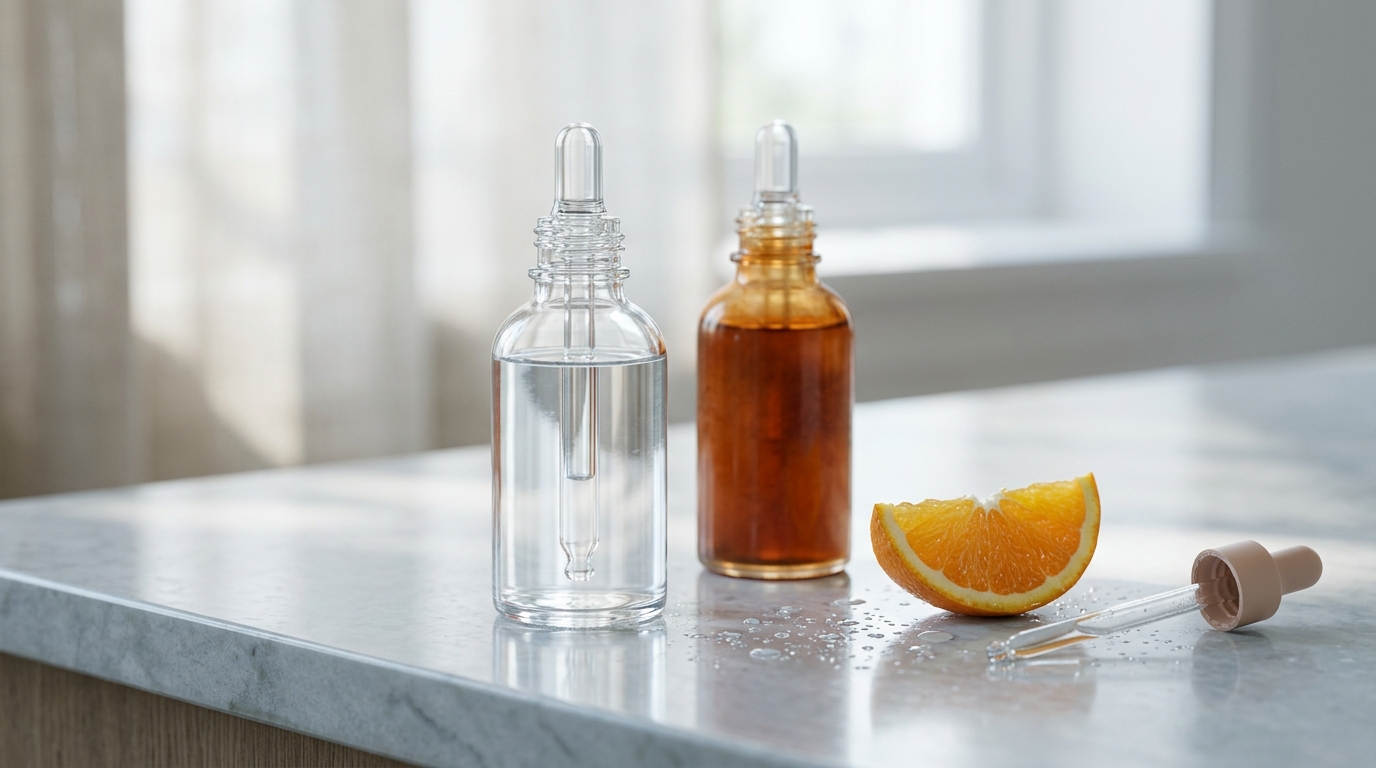
If your vitamin C serum turned orange, stung your face, or just did nothing, you're not the problem, the form of vitamin C probably is. Here's what's actually going on and what to reach for instead.
Quick Answer: Why did vitamin C stop working for you?
Most people who "give up" on vitamin C were using pure L-ascorbic acid, which oxidizes fast, stings at its low pH, and turns orange within weeks. Switching to a stable derivative like sodium ascorbyl phosphate (SAP) usually fixes the stinging, the disappointment, and the wasted money, same brightening benefit, none of the drama.
The Situation You're In
Your vitamin C wasn't the failure, the form you were sold was, and that's a really common trap.
Here's how it usually goes: you bought the serum everyone raved about. It was maybe pricey, maybe not. You used it for a few weeks, felt a little sting, told yourself that meant it was "working." Then one morning you noticed the liquid had gone from clear to amber to full-on burnt orange. Maybe you broke out. Maybe you saw literally nothing change. And somewhere in there you quietly decided vitamin C just isn't for you.
I get it. Wasting money on the wrong product is the worst, and when the wrong product happens to be the most hyped ingredient in skincare, it feels personal, like everyone else got the memo except you.
You didn't do anything wrong. You just got handed the most temperamental version of vitamin C and told it was the only one that counts.
Why This Happens
Let's check the label. When people say "vitamin C," they almost always mean L-ascorbic acid, pure vitamin C. It's the form with the most research behind it, which is exactly why it dominates marketing. But it has three real-world problems that the ads skip over.
First, it's unstable. L-ascorbic acid oxidizes the second it meets light, air, and water. That orange color you saw? That's the serum breaking down into a byproduct that can actually be pro-inflammatory. You were essentially rubbing rust into your face. Once it's brown-orange, it's done, and depending on storage, that can happen in a matter of weeks.
Second, it's acidic. To stay active, L-ascorbic acid needs a low pH (usually around 3.5 or lower). For a lot of people, especially anyone with sensitive or barrier-compromised skin, that low pH stings, flushes, and irritates. That "tingle" a lot of us learned to interpret as effectiveness is often just low-grade irritation.
Third, and this is the one nobody warns you about, irritation causes breakouts. Yeah, that ingredient combo would wreck me too. When you inflame your skin daily with an acidic, oxidizing serum, you can trigger the exact post-inflammatory marks you were hoping to fade. That's a maddening loop, and it's why so many people conclude "vitamin C breaks me out" when it's really the form and the pH doing the damage.
The good news: L-ascorbic acid is not the only game in town. K-beauty leaned into derivatives years ago precisely because they solved these problems.
What Actually Works
1. Switch to a stable derivative (this is the big one)
The fix for basically every complaint above is sodium ascorbyl phosphate, or SAP. It's a water-soluble vitamin C derivative that stays stable in the bottle instead of oxidizing on you. Your skin's own enzymes convert it into active vitamin C once it's absorbed, so you still get the brightening, it just doesn't fall apart before it gets there.
The part that matters most if you've been burned before: SAP sits at a near-neutral pH (around 7), so it doesn't sting the way L-ascorbic acid does. That makes it genuinely usable for sensitive and reactive skin, your skin type, not the internet's idea of what "real" vitamin C has to feel like.
If you have oily or breakout-prone skin, SAP is arguably a better pick than pure C anyway. It's non-comedogenic, water-based (so no added greasiness), and it has a mild antimicrobial angle that helps fade old acne marks while you're at it.
Grounded pick: the Neogen Dermalogy Real Vita C Serum (4.5 stars across roughly 4,200 reviews). Sodium ascorbyl phosphate is the second ingredient on its verified list, right after water, so the derivative is doing the actual work here rather than sitting at the bottom of the label for marketing purposes. It also carries niacinamide, which is a sensible partner for the fading-marks job.
One warning worth more than any recommendation: a product with "Vitamin C" or a big number on the front is not automatically a derivative. Plenty of ampoules marketed for sensitive skin are high-percentage pure L-ascorbic acid, which is the exact thing that burned you. Turn the box over and read the second or third ingredient. If it says "ascorbic acid," that is the pure form no matter what the front of the bottle promises. If it says sodium ascorbyl phosphate, ascorbyl glucoside, or 3-O-ethyl ascorbic acid, that's a derivative. You can browse more brightening options on the serums and essences pages if you want to compare.
2. Support it with hydration, C works better on an intact barrier
Here's a thing the vitamin C hype leaves out: it performs best when your barrier is happy. SAP brightens but doesn't hydrate on its own, so pairing it with a good humectant layer makes a real difference.
A simple, no-drama base is the Klairs Supple Preparation Unscented Toner. It's fragrance-free and built on sodium hyaluronate, beta-glucan, and centella asiatica, humectants and soothers that give your vitamin C a calm, hydrated surface to work on instead of a dry, irritated one. Layer it before your ampoule and you've solved half the "vitamin C irritates me" problem right there.
3. Stop stripping your skin at the cleanse step
If your face already feels tight and raw before the serum even goes on, that's a setup for irritation. A gentle, non-stripping cleanser keeps your barrier intact so the actives don't have to fight through a compromised surface.
For a gentle daily wash, the Illiyoon Ceramide Ato Foam Cleanser (4.6 stars across roughly 5,800 reviews) cleans without that squeaky-tight feeling. And on days you're just doing a light removal, Bioderma Sensibio H2O micellar water is about as fragrance-free and low-irritation as it gets. Full breakdowns live on the cleansers page.
4. Actually wear sunscreen, vitamin C is a daytime team player
Vitamin C's whole job is antioxidant protection and fading dark spots. Skip sunscreen and you're undoing the fade every single day. This is probably the single biggest reason people think their C "does nothing."
If you want a sunscreen that doubles as light coverage, the Goodal Heartleaf Calming Tone Up Sun Cream SPF50+ PA++++ (4.5 stars across roughly 6,400 reviews) is a sensible pairing with a brightening routine: the heartleaf keeps it calming rather than irritating, and the tone-up finish evens out redness while you wait on the actual fading. More options on the sunscreens page.
One caveat if you buy K-beauty SPF at a US retailer, and it matters here because vitamin C without sun protection is close to pointless: Korean sunscreens sold in the US are frequently reformulated with FDA-approved filters and test measurably weaker than the Korean-market versions. Consumer Reports found Beauty of Joseon's SPF 36 came out around SPF 19 in the US, and Round Lab's SPF 46 near SPF 16. Even the Korean formulas tested under their SPF 50+ labels, and the gap is narrowing since the FDA approved bemotrizinol in 2026. Apply generously and reapply.
Key Takeaways
- The form matters more than the marketing. L-ascorbic acid is powerful but unstable, acidic, and irritating for a lot of people.
- If your serum turned orange, it was oxidized, that's spent product, not proof it's strong.
- Stinging isn't "working." It's often low-grade irritation that can trigger the exact spots you're trying to fade.
- Sodium ascorbyl phosphate (SAP) is the low-drama swap: stable in the bottle, near-neutral pH, great for sensitive and oily skin.
- Barrier + sunscreen make or break results. Hydrate underneath, protect on top, or vitamin C can't do its job.
Frequently Asked Questions
Is vitamin C supposed to sting?
Not really. A brief mild tingle can happen with L-ascorbic acid because of its low pH, but ongoing stinging, redness, or burning is irritation, not effectiveness. Stable derivatives like sodium ascorbyl phosphate sit at a near-neutral pH and generally don't sting at all, which is why they're the better call for sensitive skin.
Why did my vitamin C serum turn orange?
Because the L-ascorbic acid oxidized. When pure vitamin C is exposed to light, air, and water, it breaks down and changes color from clear to yellow to orange-brown. Once it's noticeably orange, it's largely inactive, and the oxidized byproduct can be irritating. That's your cue to toss it, and a reason to consider a stable derivative next time.
Can vitamin C cause breakouts?
Indirectly, yes. It's less that vitamin C is comedogenic and more that an irritating, acidic serum can inflame your skin and trigger post-inflammatory marks or breakouts. Switching to a gentler form like SAP and supporting your barrier usually stops the cycle. If you're breaking out and not sure which product is the culprit, our post on why snail mucin breaks some people out walks through the same detective process.
Is a vitamin C derivative as good as pure vitamin C?
For everyday brightening and antioxidant protection, derivatives like SAP hold up really well, and for sensitive or oily skin, they're often the smarter choice because they're stable and non-irritating. Pure L-ascorbic acid has more direct research behind it, but that research doesn't help you if the product oxidizes or your skin can't tolerate it.
How do I store vitamin C so it lasts longer?
Keep it away from light and air. Opaque or airless packaging helps, and storing it somewhere cool and dark slows oxidation. This is mostly a concern for L-ascorbic acid, stable derivatives like SAP are far more forgiving, which is part of their appeal.
The Bottom Line
If vitamin C let you down, it probably wasn't the ingredient, it was L-ascorbic acid's fragility and low pH working against your skin type. Swapping to a stable derivative like sodium ascorbyl phosphate solves the stinging, the orange-serum waste, and the irritation loop, and it plays much nicer with sensitive and oily skin. Layer it on a hydrated base, wear sunscreen, and you'll finally see what all the fuss was supposed to be about.
You can dig into the science on any of these on the ingredient encyclopedia, and if you're not sure which vitamin C form actually fits your skin, or what's safe to layer it with, you can ask the advisor right here on this page and get a read on your specific situation.