How to Build a Korean Skincare Routine That Works
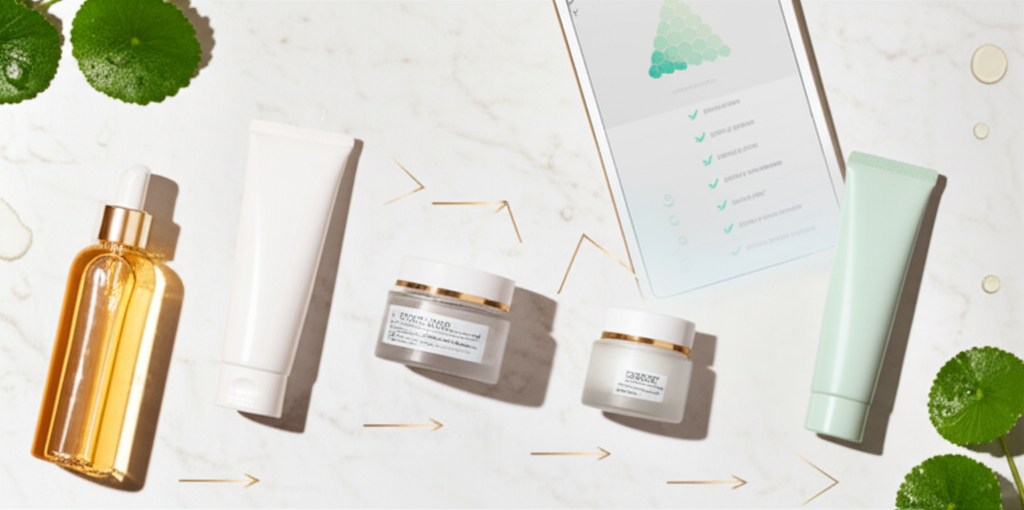
Building a Korean skincare routine shouldn't feel like solving a puzzle. Here's how to pick the right products, layer them correctly, and avoid the ingredient conflicts that cause breakouts.
Quick Answer
Question: How do you build a Korean skincare routine that works for your specific skin without causing breakouts or burning through your budget?
Answer: Forget the 10-step ideal for now. Start with just four products: an oil cleanser, a water-based cleanser, a moisturizer matched to your skin type, and a Korean SPF 50+ PA++++ sunscreen. Layer everything from thinnest to thickest consistency, introduce only one new product every two weeks, and always check whether your actives play nicely together before combining them. A focused routine with the right products will consistently beat a bloated one full of impulse buys. If you want a second opinion, Yuri, Seoul Sister's free AI advisor here on this page, can help you verify ingredients, flag conflicts, and build a routine that actually fits your skin instead of someone else's. No account needed.
The Situation You're Probably In Right Now
Last week you watched a 20-minute YouTube breakdown of someone's "holy grail" routine. Before that, you fell down a Reddit rabbit hole about double cleansing techniques. Somewhere in between, a TikTok video convinced you to order a snail mucin essence and a centella toner you'd never heard of two days earlier.
Now you've got six or seven products lined up on your bathroom counter, and? Your skin might actually look worse than before you started. Maybe there's a weird patch of redness near your jawline. Maybe your forehead feels oilier even though you added a hydrating serum that was supposed to help. You're not sure what order to apply things in, you don't know if two of your products are secretly fighting each other, and you're starting to wonder if you just wasted $90 on stuff that doesn't work for you.
If this sounds familiar, you're in the majority. Most people who get into K-beauty go through this exact frustrating phase. The good news is that the problem usually isn't your skin. It's the approach.
Why Korean Skincare Feels So Confusing (Even Though It Shouldn't)
The whole "10-step Korean skincare routine" thing was always more of a cultural shorthand than a literal instruction manual. It was meant to describe the possible steps in a full routine, not a minimum requirement. But the internet flattened that nuance pretty quickly, and suddenly people felt like they needed ten products to do K-beauty "right." That created a really specific kind of problem: beginners buying an entire lineup at once, slapping everything on in the same week, and having zero ability to tell what's helping, what's useless, and what's actively making things worse.
But the confusion goes deeper than just too many steps.
Most K-beauty products have labels written primarily in Korean. Even when there's an English ingredient list on the back, it doesn't tell you anything about how those ingredients interact with the other products you're using. Layering a retinol directly under a chemical exfoliant can seriously compromise your moisture barrier. Stacking a strong vitamin C with an acid exfoliant on the same morning can leave sensitive skin stinging for hours. These aren't rare edge cases. They're mistakes people make all the time because nothing on the product packaging warns you about them.
Then there's the personalization problem. The influencer whose routine you're copying probably has a different skin type than you, lives in a different climate, and might be dealing with completely different concerns. Someone with oily skin in Seoul's humid summers needs a wildly different approach than someone with dry, reactive skin in a Denver winter. Your skin also changes throughout the year, shifts with your hormonal cycle, and reacts differently depending on stress levels and sleep quality. A static routine can't account for any of that.
And I haven't even mentioned the money issue. The same product that costs \u20a914,000 (roughly $10-12) in an Olive Young store in Gangnam often shows up on US reseller sites for $30 or $35, with no real transparency about why. When you're buying based on TikTok hype without knowing whether a product actually matches your skin profile, those markups add up fast. People regularly spend $150+ assembling a routine that was never right for them in the first place. Seoul Sister's Price Comparison shows you a product's price across the retailers we track (led by Olive Young, with Soko Glam and iHerb where available) so you can spot inflated markups instantly.
Finally, there's the authenticity question that almost nobody talks about. Counterfeit K-beauty products are a genuine issue on third-party marketplaces, and most consumers have no reliable way to verify what they're getting. If a product isn't working, it's worth asking whether you even received the real thing. Seoul Sister's guide to spotting fake Korean skincare walks through a five-point authenticity check you can run before you put anything on your face.
What Actually Works: Building Your Routine the Smart Way
Start with four products. Just four.
Your foundation routine needs an oil-based cleanser (to remove sunscreen, makeup, and sebum), a gentle water-based cleanser (to clean what the oil cleanser loosened), a moisturizer appropriate for your skin type, and a broad-spectrum sunscreen rated SPF 50+ PA++++. Korean sunscreens are genuinely excellent here because they tend to be cosmetically elegant, meaning they actually feel nice on your skin instead of leaving a greasy white cast.
One thing to know if you are buying in a US store: Korean sunscreens sold through US retail are frequently reformulated with FDA-approved filters and test measurably weaker than the Korean-market version of the same product. Consumer Reports testing found Beauty of Joseon's SPF 36 came out around SPF 19 in the US, and Round Lab's SPF 46 tested near SPF 16. It is not "American bad, Korean good", even the Korean formulas tested under their SPF 50+ labels, and the gap is narrowing now that the FDA approved a new filter (bemotrizinol) in 2026. Just know what you are buying, and apply generously. If finding the right sunscreen feels overwhelming, Seoul Sister's best Korean sunscreens list is a good place to start, and Yuri, right here on this page, can help you narrow it down by PA rating, white cast, finish, and whether it works under makeup, free and no signup needed.
This core handles the three things that matter most: getting your skin properly clean, keeping it hydrated, and protecting it from UV damage. Everything beyond these four products is a targeted addition that you layer in based on specific concerns like hyperpigmentation, acne, fine lines, or uneven texture.
If you have oily or acne-prone skin, lean toward a lightweight gel moisturizer and an oil cleanser that rinses clean without residue. If your skin runs dry or sensitive, look for a richer cream moisturizer with ceramides and a micellar or low-pH water cleanser that won't strip what little moisture you have.
Layer by consistency, thinnest to thickest
Once you move beyond the core four and start adding toners, essences, serums, or ampoules, the layering rule is straightforward: apply products in order of their texture weight. Watery toners go on first, right after cleansing. Then essences, which tend to be slightly more viscous. Then serums or ampoules. Then moisturizer. Then sunscreen in the morning, or a sleeping mask at night if you're using one.
This isn't some arbitrary K-beauty tradition. It's basic product absorption logic. Heavier, more occlusive products create a film on your skin's surface. If you put them on first, the lighter products you apply afterward can't penetrate properly, and you've essentially wasted them. Think of it like getting dressed: you don't put your coat on before your shirt.
If you tell Yuri which products you own, she can lay out the correct AM/PM sequence for you, with wait-time guidance between actives. She's free to chat with right here on this page, no account needed.
Introduce one product at a time, and give it two full weeks
I know this is the advice nobody wants to hear because it requires patience, but it's genuinely the most important rule in this entire post. If you add a new toner, a new serum, and a new moisturizer in the same week and then break out on day five, you have absolutely no way to identify the culprit. Was it the toner? The serum? An interaction between the two? You'll never know, and you'll probably end up throwing away something that was actually fine.
Two weeks is the minimum window for your skin to adjust to a new product and show you a real response. Some reactions are immediate (burning, stinging, visible redness), but others take several days to emerge. Clogged pores from a comedogenic ingredient, for instance, might not show up as a breakout until a week or more after you start using the product.
Keep a simple log of what you introduced and when. It doesn't need to be fancy. A note on your phone with the date, product name, and any observations is enough.
Check ingredient interactions before you combine actives
Some ingredient pairings work beautifully together. Hyaluronic acid and ceramides complement each other well, as do niacinamide and zinc. Centella asiatica and panthenol are another solid combination for calming irritated skin.
Other pairings need to be separated, either by using one in the morning and the other at night, or by waiting 15-20 minutes between applications. The most common conflicts people run into:
- Retinol + AHA/BHA exfoliants: Using both in the same routine can over-exfoliate and damage your moisture barrier. Alternate nights, or use one in the morning and one at night (with sunscreen being non-negotiable if you're using either).
- Not a conflict, despite what you have read: vitamin C + niacinamide. The "they cancel each other out" claim comes from 1960s research using raw, non-cosmetic forms at high heat, and it does not describe modern formulations. You can use them together. What is true is that high-percentage niacinamide on its own (think 10% and up) makes some people flush, which is a niacinamide tolerance issue rather than anything to do with vitamin C. If that is you, drop to a lower percentage rather than separating the two.
- AHA/BHA + retinol + benzoyl peroxide: Stacking all three is a recipe for a wrecked skin barrier. Pick your battles and use them on different nights.
- Multiple exfoliating acids in one routine: If your toner has glycolic acid and your serum has salicylic acid, you might be over-exfoliating without realizing it. Check every product's active ingredients, not just the ones marketed as "treatments."
This is where things get tricky for most people, because you'd need to cross-reference ingredient lists across multiple products, and half of those lists are in Korean. Yuri can do that cross-checking with you on this page. You can also look up any ingredient in the Ingredient Encyclopedia to check safety ratings, comedogenic scores, and effectiveness by skin type.
Adjust your routine with the seasons (and your skin's cycles)
A routine that works perfectly in August might leave your skin feeling tight and flaky in January. Humidity, temperature, indoor heating, and even air travel all affect how much moisture your skin needs and how it responds to active ingredients.
As a general guideline: in warmer, more humid months, you can usually get away with lighter moisturizers and more active treatments because your skin barrier tends to be more resilient. In colder, drier months, scale back on exfoliating acids, switch to a richer moisturizer, and maybe add a hydrating toner or essence layer you skip in summer.
Your skin also shifts with your hormonal cycle if you menstruate. The week before your period, your skin tends to produce more oil and become more breakout-prone. That's not the ideal time to introduce a new product or go heavy on rich creams. The week after your period, your skin is typically calmer and more tolerant, which makes it a better window for trying something new.
Paying attention to these patterns sounds like a lot of work, but once you start tracking, it becomes second nature. And it saves you from blaming a perfectly good product for a breakout that was actually hormonal.
Stop buying based on hype alone
A product trending on TikTok with 4 million views tells you one thing: it's popular. It doesn't tell you whether it's compatible with your skin type, whether it'll conflict with your existing products, whether the version sold on Amazon is authentic, or whether it's worth the US markup over what it costs in Korea.
Before you buy anything, ask yourself three questions:
- What specific concern am I trying to address? If you can't name one, you probably don't need the product right now.
- Do the key ingredients make sense for my skin type? A heavy snail mucin cream might be incredible for dry skin and completely wrong for someone who's oily and acne-prone.
- Will it play well with what I'm already using? This is the question most people skip, and it's the one that causes the most problems.
Seoul Sister helps you answer all three before you spend a dollar. Search the product database for a full ingredient breakdown and price comparison so you know if you're paying a fair price or a 200% markup, and if you're not sure whether a product fits your skin type and your current routine, ask Yuri in the free chat on this page, no account needed.
Common Mistakes to Avoid
Over-cleansing. If your skin feels "squeaky clean" after washing, you've stripped too much. Your cleanser should remove dirt, oil, and sunscreen without leaving your skin feeling tight or dry. A lot of people with oily skin think they need harsh cleansers, but stripping your skin's natural oils actually triggers more oil production. It's counterproductive.
Skipping sunscreen because your moisturizer has SPF 15. SPF 15 in a moisturizer is not adequate sun protection, especially if you're using any actives like retinol, AHAs, or vitamin C that increase photosensitivity. Korean sunscreens with SPF 50+ PA++++ are widely available, feel lightweight, and many work well under makeup. There's really no excuse to skip this step.
Using expired products without realizing it. Every product has a PAO (Period After Opening) symbol, that little jar icon with a number like "12M" on it. It means the product should be used within 12 months of opening. Using products past their PAO can mean reduced effectiveness at best and bacterial contamination at worst. If you can't remember when you opened something, start writing the open date on the bottom of the jar with a marker when you first crack the seal. It takes five seconds and settles the question for good.
Copying someone else's exact routine. I know it's tempting when someone with beautiful skin posts their full product lineup. But their skin isn't your skin. Use other people's routines as inspiration and starting points, not as prescriptions. The products that work for you will be determined by your skin type, your climate, your concerns, and how your skin reacts, and that combination is unique to you.
A Sample Starter Routine to Build From
Morning:
- Water-based cleanser (or just rinse with lukewarm water if your skin is dry or sensitive)
- Moisturizer (gel for oily skin, cream for dry skin)
- Sunscreen SPF 50+ PA++++
Evening:
- Oil-based cleanser (to remove sunscreen and any makeup)
- Water-based cleanser
- Moisturizer
That's it to start. Once your skin is comfortable with this for two to three weeks, you can begin adding one targeted product at a time. A hydrating toner if you want more moisture. A niacinamide serum if you're dealing with uneven tone or enlarged pores. A gentle BHA if you're prone to blackheads. Build slowly, track your results, and adjust based on what your skin tells you.
Where Seoul Sister Fits In
Building a Korean skincare routine shouldn't require you to learn Korean, memorize ingredient interaction charts, or spend hours cross-referencing Reddit threads. Seoul Sister was designed to take the guesswork out of the process.
The Ingredient Encyclopedia tells you exactly what an ingredient does before you buy a product built around it. And the product database shows you prices from the retailers we track (led by Olive Young, with Soko Glam and iHerb where available) so you're not unknowingly paying triple for the same product.
If you want personalized guidance, Yuri is Seoul Sister's AI skincare advisor, free to chat with right here on this page, no account needed. She has access to real-time product data and ingredient conflict detection. You can ask her anything from "what order should I apply these three products?" to "is this product safe for sensitive skin?" and get an answer grounded in actual data, not generic advice.
Whether you're just getting started with K-beauty or you've been doing it for years and want to make smarter choices, the goal is the same: a routine that's actually built around your skin rather than borrowed from a stranger on the internet. If you want a second opinion on yours, start a free chat with Yuri right on this page, no account needed.