Korean Moisturizer or Barrier Cream? How to Tell What Your Skin Actually Needs
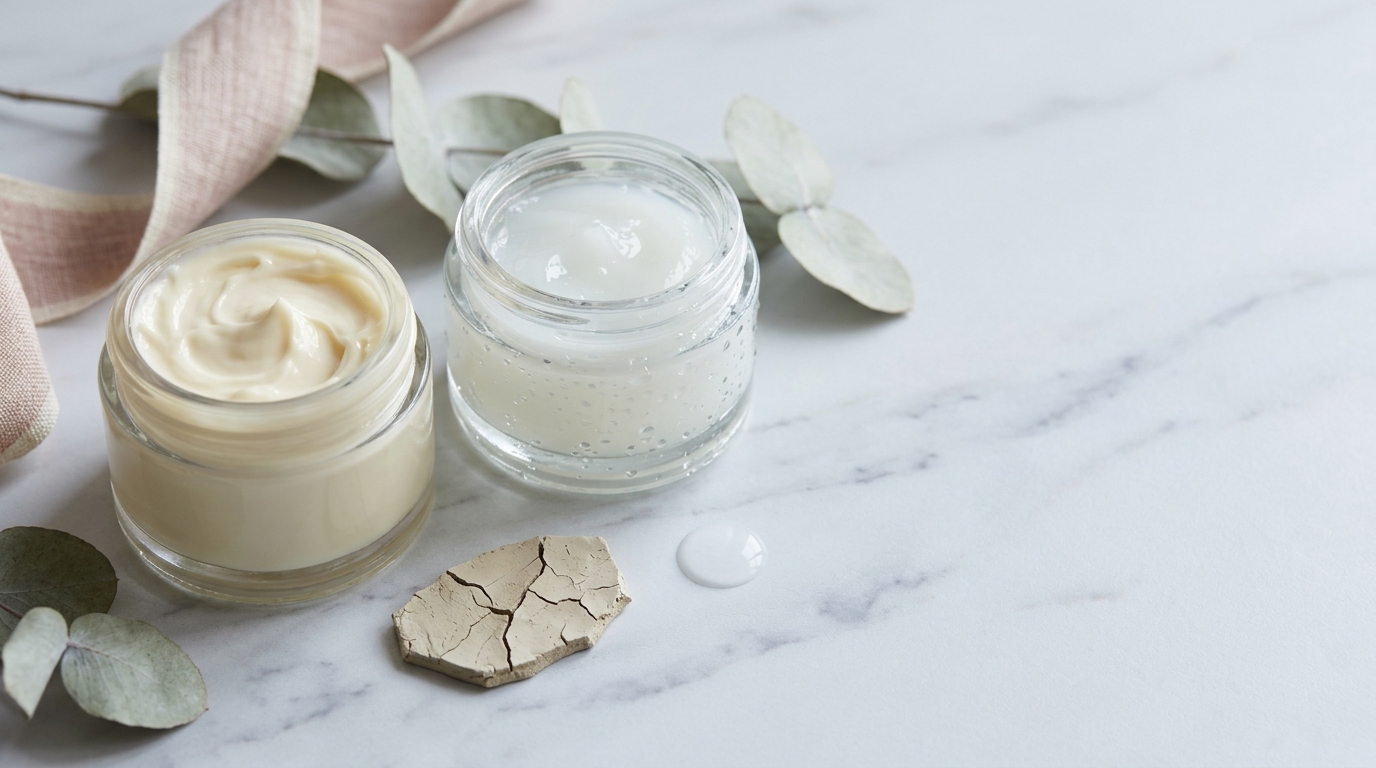
A moisturizer is a delivery system with three jobs, and the label rarely says which one you are buying. How to tell damaged from dehydrated, read the ingredient list, and pick accordingly.
Quick Answer: Do You Need a Barrier Cream or Just a Moisturizer?
If your skin stings when you apply products that used to feel fine, you need a barrier cream: something with ceramides, cholesterol and fatty acids to rebuild what is missing. If your skin feels tight and looks dull but does not sting, you are dehydrated, and you need water plus something to seal it in. The mistake almost everyone makes is buying a light, watery "hydrating" cream for genuinely dry skin. Water with nothing to hold it in evaporates, and it can take your own moisture with it, so your skin ends up tighter an hour later than before you started.
A moisturizer is not one thing. It is a delivery system doing up to three separate jobs, and the label almost never tells you which one you are buying.
Damaged or Just Dehydrated? Answer This First
These two get treated as the same problem and they are not. Buying for the wrong one is why a well reviewed cream can do nothing for you.
Your barrier is damaged if: products that were fine last month now sting, burn or tingle on contact. Your skin is red or flushed without an obvious cause. It feels rough or papery in patches. You are breaking out in a pattern that is not your usual one. The tell is reactivity. Something that never bothered you now does.
You are dehydrated if: your skin feels tight, especially after cleansing. It looks dull or flat and fine lines look more obvious than they did. Makeup clings and separates. But nothing stings. You can put on your usual products and they behave normally. Dehydrated skin is short on water, not broken. Oily skin gets dehydrated constantly, which is why "my skin is oily and tight at the same time" is so common and so confusing.
If both are true, treat the damage first. A compromised barrier cannot hold water no matter how much humectant you throw at it, so hydration will not stick until the wall is repaired.
The practical difference: dehydration can often be fixed in a week or two with more water and a decent seal. Barrier damage takes four to six weeks of leaving your skin alone, and the first thing to do is stop whatever caused it. If you want the longer diagnostic version, we go deeper in how to tell if your skin barrier is damaged.
The Three Jobs a Moisturizer Can Do
Nearly every moisturizer on the shelf is some ratio of three ingredient types. Once you can see the ratio, the marketing stops mattering.
Humectants draw water in. Glycerin, hyaluronic acid, betaine, panthenol, propanediol, sorbitol. They pull moisture from deeper in the skin and from the air around you. They are why a product feels instantly plumping. On their own, in dry air, they can pull water up and let it evaporate straight off, which is the hydrator trap below.
Emollients soften and smooth. Squalane, caprylic/capric triglyceride, jojoba and sunflower seed oils, fatty alcohols like cetearyl and behenyl alcohol. These fill the gaps between skin cells so the surface feels soft rather than rough. They are what makes a cream feel like a cream.
Occlusives seal it in. Petrolatum, shea butter, beeswax, dimethicone, heavier silicones, mineral oil. They sit on top and slow water escaping. This is the job people skip, and it is the one that decides whether the other two hold.
Most good creams do all three. The ratio is what changes, and the ratio is what should match your skin.
How to Read the First Five Lines
Turn the box over. Ingredients are listed in descending order down to about one percent, so the top of the list is most of what you are buying.
If lines two through five are all humectants and water, you are holding a hydrator. Excellent under makeup, excellent on oily skin, not enough on its own if your skin is genuinely dry.
If you see an oil, a fatty alcohol or a triglyceride in the first five, there is real emollient content and it will feel like a cream.
If you see dimethicone, shea butter or petrolatum high up, it is built to seal. That is what you want at night on dry or damaged skin.
Ceramides, peptides and the interesting actives usually sit lower on the list. That is normal and not a problem. They work at low percentages. What matters is that the top of the list matches the job you need done.
The Hydrator Trap, and Why Your Skin Feels Tighter After Moisturizing
This is the single most common mistake in this category, so it gets its own section.
A light water cream or gel floods your skin with humectants and almost nothing else. It feels wonderful going on. Twenty minutes later it feels fine. An hour later your skin feels tighter than it did before you applied anything.
Here is why. Humectants move water toward wherever it is driest. Indoors in winter, or in air conditioning, the driest thing in the room is the air. So the humectant pulls water up through your skin and hands it to the atmosphere, and you finish with less moisture than you started with. Water without a lid does not stay.
The fix is not a better hydrator. It is a lid. Apply your hydrating layer to skin that is still slightly damp, then put something occlusive over it within a minute. That single change fixes more "my moisturizer stopped working" complaints than switching products ever will.
Ceramides: Replacing What Is Missing
Picture your outer skin as a brick wall. The cells are the bricks, and the lipid layer between them is the mortar. Ceramides are roughly half that mortar, with cholesterol and fatty acids making up most of the rest.
Dry, damaged and older skin is measurably short on ceramides. That is the whole reason ceramide creams work: you are not adding a foreign active, you are topping up a material your skin already uses and has run low on. It also explains why they feel unremarkable. There is no tingle and no glow, just skin that stops complaining after a couple of weeks.
The three work best together, in roughly balanced proportion, which is why the strongest barrier formulas list cholesterol and fatty acids alongside the ceramide rather than the ceramide alone. In Seoul Sister's catalog, Aestura Atobarrier365 Cream is the clearest example of that full set: its verified ingredient list carries Ceramide NP together with cholesterol, stearic acid and palmitic acid, plus squalane and dimethicone to seal. Illiyoon Ceramide Ato Concentrate Cream takes a related approach, though its ceramide content is listed as hydroxypropyl bispalmitamide MEA, a synthetic ceramide analogue rather than a true ceramide. It behaves similarly on skin. It is just worth knowing the label is not saying quite what it appears to.
One honest caveat on shopping by the word "ceramide": it appears on the front of a lot of boxes where the ingredient sits near the bottom of the list at a token amount. The front of the box is not evidence. The ingredient list is.
Matching the Formula to Your Skin
Dehydrated but oily
You want humectant-led with a light seal, not a rich cream. Gel creams are built for exactly this. Physiogel DMT Hydro Gel Cream is glycerin-led with panthenol, hyaluronic acid and squalane, and its verified list includes Ceramide NP lower down, so you get a little barrier support without the weight.
Do not skip the seal because your skin is oily. Oily and dehydrated is the most common version of this problem, and skipping the occlusive is what keeps it going.
Truly dry
You need ceramides and a real occlusive, and you need to stop being precious about texture. Aestura Atobarrier365, described above, is the straightforward answer. Applied to slightly damp skin at night, a genuinely occlusive layer is doing more work than any active in your routine.
Combination
The usual mistake is insisting on one product for the whole face. Your cheeks and your T-zone are not in the same condition and there is no rule that they get the same cream. Gel cream where you are oily, richer cream where you are dry. It takes ten extra seconds.
Sensitive or reactive
Short ingredient lists and no added fragrance. This matters more than any hero ingredient, and it is where you have to read carefully, because brand names mislead. Real Barrier Aqua Soothing Gel Cream sounds like the obvious sensitive pick, but its verified list contains linalool and limonene along with bergamot and other aromatic oils. TOCOBO Multi Ceramide Cream has an impressive five ceramide types, and also contains fragrance (parfum) and linalool.
The genuinely fragrance-free ceramide options in the catalog are narrower than the shelf suggests. Dr. Jart+ Power Derma Barrier Cream and Purito Dermide Cica Barrier Cream both list Ceramide NP with no fragrance and no aromatic essential oils. Purito's is the shorter list of the two at twenty four ingredients, with panthenol, squalane and centella. Note that Aestura's Dr. Ceramide Cream, despite the name, does contain patchouli, vanilla and lavender oils, so it is not a fragrance-free option even though its ceramide content is high.
If you want the shortest list available and can do without ceramides, Etude SoonJung 2x Barrier Intensive Cream runs to seventeen ingredients with shea butter as the occlusive and panthenol and madecassoside to calm. It has no ceramides in its verified list, so it is a soothing cream rather than a barrier-rebuilding one. That is a real distinction, not a small one.
Barrier repair after retinoids or acids
Stop the active entirely for one to two weeks. Not a reduced schedule, a full stop. Then keep the routine to a gentle cleanser, one simple ceramide cream and sunscreen. Nothing with an acid, no vitamin C, no exfoliating anything, no new products at all while you are healing. The most common reason barrier repair fails is that people keep one active in the routine because it seemed mild.
Seasonal Switching Is Not Marketing
The same skin wants a different seal in January than in July. Cold air holds less water and indoor heating strips what is left, so a gel cream that was perfect in summer can leave you tight in winter. Nothing has gone wrong with your skin or the product.
The cheapest fix is to keep both and switch, or keep your usual cream and add an occlusive layer on top at night only during the cold months. You do not need a new routine twice a year, you need a different lid.
Keep Your Western Moisturizer If It Works
This section is going to cost us sales and it is still the right advice.
CeraVe, Vanicream, La Roche-Posay and Cetaphil make genuinely good moisturizers. CeraVe's ceramide and cholesterol formulas are well built. Vanicream is one of the best options anywhere for reactive skin because the list is short and boring in the best way. If one of these is working for you, there is no reason to switch, and anyone telling you Korean skincare is categorically better is selling you something.
Where Korean formulas do tend to win is texture at a given weight. There is more of a genuine range between "barely there" and "rich", so it is easier to find something that hydrates properly without feeling heavy, and gel cream textures for dehydrated oily skin are more developed. That is a real advantage for some people and irrelevant for others. Switch if the texture of what you own is the problem. Do not switch because a cream has Korean text on the box.
And on sealing specifically: plain petrolatum is one of the most effective occlusives that exists. A thin layer on damp skin, at night, over your moisturizer. It costs almost nothing, we do not sell it, and for badly compromised or very dry skin it outperforms most of what you could spend real money on. Anyone who will not tell you that is not being straight with you.
When to Stop Buying Creams and See a Dermatologist
A cream is not the answer to everything. See a professional if your skin is painful rather than uncomfortable, if it is cracked, weeping, bleeding or crusting, if redness is spreading or you have swelling or warmth that could be infection, or if you have been doing everything right for six to eight weeks with no improvement at all.
Persistent barrier failure that does not respond can be eczema, seborrheic dermatitis, perioral dermatitis or rosacea, and those need treatment, not a better moisturizer. Buying a fourth cream instead of getting it looked at is how people lose months.
Where to Buy
For the Korean products named here, Olive Young Global, Soko Glam and iHerb are the retailers we recommend. Prices move around and vary by retailer and promotion, so check the live product page rather than trusting a number in an article, including this one.
Frequently Asked Questions
What Korean barrier cream should I use if I am not sure whether my skin is damaged or just dehydrated?
Use the sting test. If products that used to feel fine now sting or burn, your barrier is damaged and you want a ceramide cream with cholesterol and fatty acids, something like Aestura Atobarrier365. If your skin feels tight and looks dull but nothing stings, you are dehydrated and you want a humectant-led gel cream with a light seal, like Physiogel DMT Hydro Gel Cream. If you genuinely cannot tell, buy for damage. A barrier cream will also fix dehydration, but a light hydrator will not fix damage, so the barrier cream is the safer bet either way.
Is a richer barrier cream or a lightweight milky toner better for compromised, dehydrated skin?
The barrier cream, if you can only pick one. Compromised skin has lost the lipids that hold water in, and a milky toner is mostly water and humectants, so it adds moisture to skin that cannot yet keep it. Use both if you like, in the right order: milky toner first while your skin is damp, barrier cream over the top to seal it. If you use only the toner on a compromised barrier, you will get an hour of relief and then feel tight again.
Can I just use a hydrating toner or essence instead of a moisturizer?
Only if your skin is oily and the weather is humid. Toners and essences are almost entirely humectant, so they add water without sealing it in. In dry air the water evaporates and can leave your skin drier than before. If you skip cream, at minimum apply the essence to damp skin and follow with something occlusive.
How long before a new moisturizer shows results?
Hydration improves within a few days. Barrier repair takes four to six weeks, because you are waiting for skin cells to turn over and the lipid layer to rebuild. If a cream makes your skin sting or itch on the first few uses, stop, that is not "purging". If nothing has improved after eight weeks of consistent use, the product is not right for your skin.
Do I need a separate day and night moisturizer?
Not necessarily, but it helps. Daytime favors something lighter that sits well under sunscreen and makeup. Night is when a heavier occlusive earns its place, since you are not worried about finish and water loss is highest while you sleep. One cream used morning and night is fine. Two is better if your skin is dry.
Are expensive moisturizers better?
Not reliably. The ingredients that do the actual work, glycerin, ceramides, squalane, petrolatum, dimethicone, panthenol, are all inexpensive and widely available. Price mostly buys texture, packaging and brand. There are excellent cheap moisturizers and mediocre expensive ones, and the ingredient list tells you far more than the price does.
The Short Version
Work out whether you are damaged or dehydrated first, because they need different products. Read the first five ingredients and check whether the formula is drawing water in, softening, or sealing, then match that to what your skin actually needs. Whatever you use, put it on damp skin and make sure something is holding the water in. If you want to go deeper on the hydration side, our guide to fixing dehydrated skin with a Korean skincare routine covers the full routine, and if you are dealing with dryness and dark spots together, Korean skincare for dry skin with pigmentation works through treating both without wrecking your barrier.
Still not sure which category you are in? Ask Yuri. Describe what your skin is doing and she will work through it with you against the actual ingredient lists.