Why Does My Skincare Keep Making My Skin Worse?
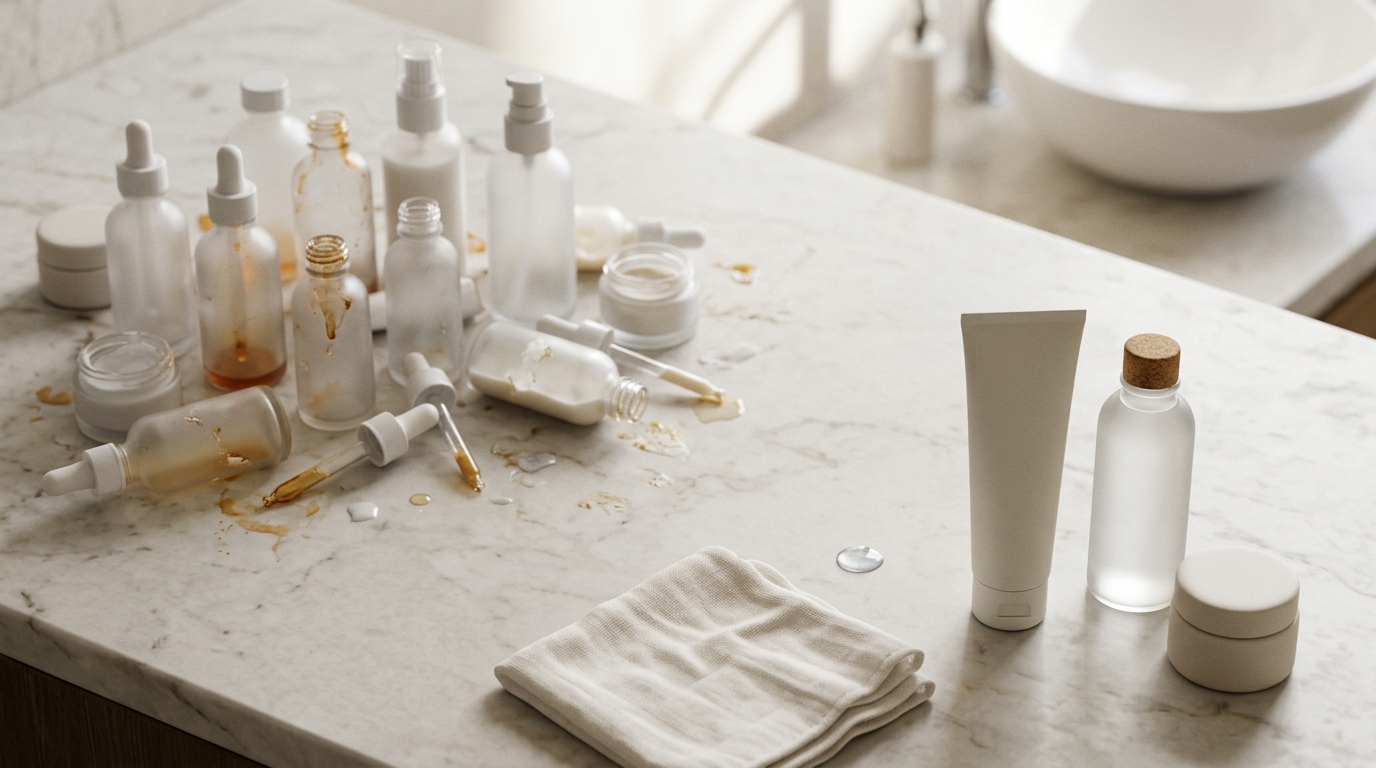
When your skin gets progressively worse the more products you add, the fix is almost never another active. It's usually your barrier waving a white flag. Here's how to figure out what's actually going wrong and rebuild from there.
Your skin isn't broken and you didn't ruin it, you're most likely dealing with a stripped barrier that gets worse every time you add another "fix" on top of it.
If you've been feeling progressively worse about your skin, you're describing one of the most common patterns I see. Someone gets into K-beauty, builds an ambitious routine, and instead of glass skin they get redness, stinging, tiny bumps, weird dryness that no amount of moisturizer touches. Then they add MORE products to solve it. And it keeps getting worse. If that's you, take a breath. This is fixable, and it's usually simpler than you think.
Quick Answer: Why Does My Skincare Keep Making My Skin Worse?
When skincare progressively makes your skin worse, it's almost always a damaged moisture barrier, usually from too many actives, over-exfoliation, or fragrance/essential oil irritation stacking up over time. The counterintuitive fix isn't adding a repair product on top of everything. It's stripping your routine back to a gentle cleanser, one hydrating layer, and moisturizer for two to three weeks so your skin can actually heal.
The Situation You're In
You started with good intentions. Maybe a vitamin C in the morning, an exfoliating acid a few nights a week, retinol on the others, an essence, a couple of serums, that trending ampoule everyone on TikTok swears by. For a while it felt productive. Then your skin started getting… weird. Tight after cleansing. Stinging when you apply things that never used to sting. Little rough bumps. Redness that comes and goes. Dryness that sits under the surface no matter how much moisturizer you pile on.
So you did the logical thing: you added more. A richer cream. A soothing serum. Another mask. And somehow it got worse. Now you're looking in the mirror feeling like your skin is actively working against you, and every new product is a gamble you can't afford to keep losing.
Here's the reframe: your skin isn't rejecting skincare. It's overwhelmed by it.
Why This Happens
Your moisture barrier is the outermost layer of your skin, the thing that holds water in and keeps irritants out. When it's healthy, products absorb nicely and your skin feels calm. When it's compromised, everything changes. Water evaporates out faster than you can replace it (that's the dryness that moisturizer doesn't fix), and irritants get in more easily (that's the new stinging and redness).
The thing is, a stripped barrier doesn't announce itself as "barrier damage." It shows up as symptoms that look like they need more treatment, dryness that reads as "I need more moisture," bumps that read as "I need to exfoliate," dullness that reads as "I need actives." So you keep feeding the fire. Over-exfoliation is the biggest culprit I see: acids plus retinol plus a scrub plus a "brightening" toner that quietly has more acid in it. It adds up faster than anyone expects.
Fragrance and essential oils are the other quiet saboteurs. A lot of gorgeous-smelling K-beauty is loaded with them, and on a healthy barrier you might never notice. On a compromised one, they're a daily low-grade irritant keeping you stuck in the red zone. And silent reformulations don't help, the product you loved a year ago may have changed, which is exactly the kind of thing worth checking when your holy grail suddenly turns on you. If you want the fuller version of the moisturizer-vs-barrier-cream question, I broke it down here.
What Actually Works
1. Strip your routine down to three steps
This feels backwards when your skin is a mess, but it's the whole game. For two to three weeks: gentle cleanser, one hydrating layer, moisturizer, plus sunscreen in the morning. No acids. No retinol. No vitamin C. No fragrance if you can help it. You're giving your barrier a chance to close up and rebuild without new insults every night.
For the cleanser, gentle and non-stripping is the entire point. A micellar water like Bioderma's Sensibio H2O is about as low-drama as cleansing gets, it lifts makeup and grime without a foaming surfactant scrubbing your skin raw, and it's fragrance-free, which matters a lot right now. If you prefer an actual wash, a milk or cream cleanser is your friend. The ma:nyo Pure Soybean Cleansing Milk is a soft, non-stripping option a lot of people reach for during a barrier reset. You can browse more gentle cleansers here.
2. Rehydrate with a genuinely boring toner
"Boring" is a compliment during a reset. You want a hydrating, fragrance-free, alcohol-free toner and nothing clever. The Klairs Supple Preparation Unscented Toner is a beginner staple for exactly this reason, its verified ingredient list is built around water, butylene glycol, betaine and sodium hyaluronate for humectant hydration, plus centella asiatica extract and licorice root to calm things down, and it skips fragrance and essential oils entirely. That's the profile you want when your skin is reactive: hydration and soothing, zero showing off.
Panthenol and centella-type ingredients are the ones I'd actually seek out here, they're the calming, barrier-supportive workhorses. More toner options here if that one isn't your vibe.
3. Seal it in, and don't overthink the moisturizer
After hydration you need something to lock it in, that's the difference between "I applied water" and "the water stayed." A simple moisturizer with ceramides or a basic occlusive layer is plenty. This isn't the moment for a 12-ingredient anti-aging cream. If you're not sure whether you need a regular moisturizer or a heavier barrier cream, this moisturizer vs barrier cream guide walks through it, and there's a full moisturizer roundup here.
4. Never skip sunscreen, but pick a gentle one
A healing barrier is more vulnerable to UV, so morning sunscreen is non-negotiable even mid-reset. You want something that won't sting. A mineral option like the Te' Chorok 35 Tone Up Sun Cushion leads with zinc oxide and titanium dioxide, which are the physical filters people with reactive skin usually tolerate best, and the cushion format makes gentle reapplication easy without rubbing raw skin.
One honest note here, because it matters if you're buying in a US store: Korean sunscreens sold in the US are reformulated with FDA-approved filters and can test meaningfully weaker than the Korean-market version of the same product, Consumer Reports found several popular ones landing well under their labeled SPF. It's not "Korean good, American bad," it's know what you're actually buying. Apply enough, reapply, and don't assume the number on the box. You can compare sunscreens here.
Once your skin is calm again, no stinging, no bumps, comfortable, you reintroduce actives ONE at a time, a couple weeks apart, so you can actually tell what your skin likes. That slow reintro is how you build a routine you'll actually stick to.
Key Takeaways
- Worse-with-more-products almost always means barrier damage, not a missing step.
- Over-exfoliation and fragrance/essential oils are the two most common causes, count how many acids and actives are quietly stacked in your routine.
- The fix is subtraction: gentle cleanser, hydrating toner, moisturizer, sunscreen, for 2–3 weeks.
- Reintroduce actives one at a time after your skin calms down.
- Check whether a beloved product silently reformulated if it suddenly started irritating you.
Frequently Asked Questions
How do I know if my skin barrier is damaged or if it's just purging?
Purging is temporary, happens only when you start an ingredient that speeds up cell turnover (retinoids, AHAs/BHAs), and shows up as breakouts in your usual breakout areas that clear within about 4–6 weeks. Barrier damage shows up as stinging, redness, tight dryness, rough texture, and reactivity to products that never bothered you before, and it doesn't resolve on its own, it needs you to back off. If you're stinging and not just breaking out, treat it as a barrier issue.
How long does it take to repair a skin barrier?
For most people, a mild-to-moderate barrier reset takes about two to three weeks of a stripped-back gentle routine before things feel calm again. More significant damage can take a month or more. The non-negotiable part is stopping the irritants, no acids, no retinol, no fragrance, because the barrier can't rebuild while it's still being disrupted daily.
Can I keep using vitamin C or retinol during a barrier reset?
Not while you're actively resetting. Both are worth having in a healthy routine, but during a reset they're exactly the kind of active that keeps your skin from calming down. Pause everything, get your skin comfortable, then reintroduce one active at a time with a couple of weeks between each so you can tell what's actually working versus what's irritating.
Is fragrance really that bad for my skin?
Not for everyone, and not always, plenty of people use fragranced products with zero problems. But on a compromised or reactive barrier, fragrance and essential oils are a common low-grade irritant that keeps you stuck. During a reset specifically, going fragrance-free removes a variable so you can actually see what your skin does without it.
The Bottom Line
If your skin has been getting progressively worse, the most useful thing you can do isn't buy a new product, it's take things away. Strip back to gentle cleanser, hydration, moisturizer, and sunscreen, hold there until your skin is genuinely calm, and reintroduce actives slowly. Your barrier does the healing; your job is to stop getting in its way.
If you want to dig into whether a specific ingredient is soothing or secretly irritating you, the free ingredient encyclopedia has safety and skin-type breakdowns, and you can browse the full product database to compare gentle options. And if you're staring at your current shelf not sure which products to pause versus keep for your skin specifically, tap Ask Yuri on this page, which opens a free chat (no account needed), and describe what you're using. She'll help you sort the reset from the reintro.