Why Simplifying Your Skincare Routine Actually Works
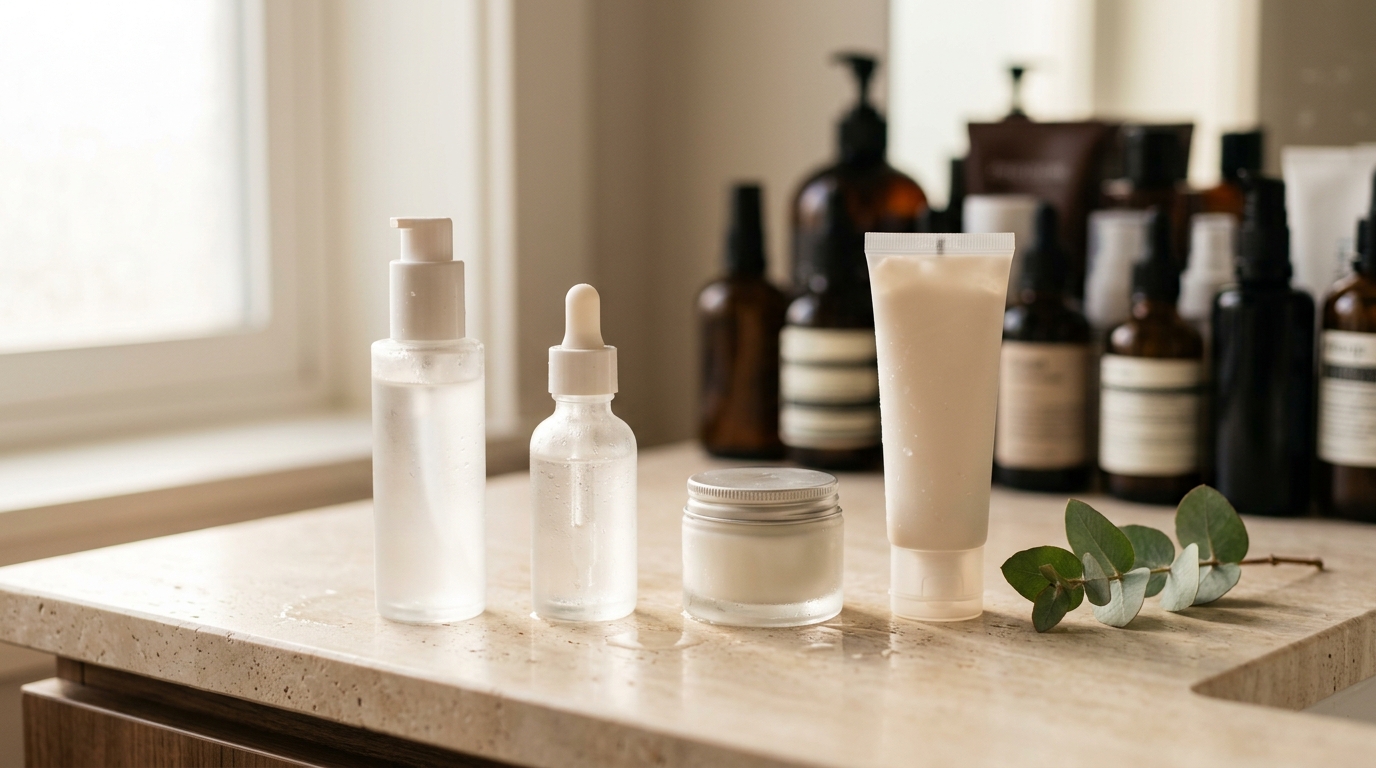
That 10-step routine might be the reason your skin is freaking out. Here's the actual science behind why cutting back often clears things up, and the few products genuinely worth keeping.
Your skin isn't broken. It's overwhelmed by everything you're piling on it. For a lot of people, that's exactly what's going on, especially if you've been layering actives, acids, and a dozen products that quietly compete with or irritate each other. Stripping back to a gentle cleanser, a hydrating layer, moisturizer, and SPF gives your skin barrier room to actually recover, which is when the glow people credit to expensive serums tends to show up.
The Situation You're In
You've got a shelf full of products. The vitamin C, the retinol, the three different acids, the seven-step Korean routine you screenshotted at 1am. And yet... Your skin is worse? More reactive, weirdly dry-but-oily, breaking out in places it never used to, stinging when you put on the next layer.
So you saw someone online say they cut their routine down and their skin got better, and now you're suspicious of everything. Did you waste all that money? Is your skin just doomed? Are you doing K-beauty wrong?
Take a breath, your skin isn't broken, it's overwhelmed. There's a real, boring, ingredient-level reason simplifying works, and it's not a vibe.
Why This Happens
Nobody tells you this when you're building a routine off TikTok: your skin barrier is a physical structure made of lipids, ceramides, and hyaluronic acid-style humectants holding everything together. When you pile on actives, acids, retinoids, vitamin C, scrubs, you're slowly disrupting that structure faster than it can rebuild. The result is what derms call "barrier impairment," and it shows up exactly as the symptoms above: redness, stinging, dehydration, surprise breakouts, and that maddening "nothing absorbs anymore" feeling.
The second issue is ingredient conflicts. A lot of popular products genuinely don't play nice together. Layering a low-pH acid under a high-pH product, or stacking multiple exfoliants because each one is in a different bottle (toner + serum + cleanser all sneaking in acids), means you're often over-exfoliating without realizing it. I can see this happening constantly, someone thinks they're using one acid, but it's hiding in four products.
And the marketing trains us to think more steps equals more results. But skin doesn't reward effort, it rewards consistency and tolerability. A simple routine you can do every day, that never stings, beats a maximalist routine that you're constantly recovering from. That's the actual mechanism behind every "I simplified and my skin cleared up" post, fewer irritants, a barrier that finally rebuilds, and ingredients that aren't cancelling each other out.
What Actually Works
1. Start with one genuinely gentle cleanser
This is where most over-complicated routines secretly go wrong, harsh, high-pH foaming cleansers that strip you before you've even started. If you wear sunscreen or makeup, double cleansing makes sense, but both steps should be non-stripping.
For the first step, a gentle cleansing milk or oil melts off SPF and makeup while keeping your moisture barrier intact, no tight, squeaky feeling. If you want something even more minimal for no-makeup days, Sensibio H2O by Bioderma is a fragrance-free micellar water built for reactive, sensitive skin, it's basically the "I can't deal with my skin right now" reset button.
For the second cleanse, the Illiyoon Ceramide Ato Foam Cleanser (about $9.50 at Olive Young, 4.6 stars across roughly 5,800 reviews) does the actual washing without stripping, so your cleanser isn't undoing the simple routine you just built. That's the simplification energy. You can browse more options on the best cleansers page.
2. Replace your acid pile-up with one hydrating layer
When you cut the actives, your skin needs hydration to rebuild, not more stimulation. This is where a clean, no-irritant toner earns its spot.
The Supple Preparation Unscented Toner by Klairs is a reliable option for exactly this situation. It's formulated without fragrance, alcohol, or essential oils, and it leans on sodium hyaluronate, beta-glucan, and centella asiatica, that last one is the calming, barrier-supporting ingredient Korean brands reach for when skin is angry. Centella (you'll see it as "cica") is genuinely one of the most studied soothing ingredients out there, and it's doing real work here, not just sitting pretty on the label.
The point of this step: hydrate and calm, full stop. No acids hiding in your "hydrating" toner.
3. Lock it in, then leave it alone
A moisturizer with ceramides seals everything in and physically replaces the lipids your over-exfoliating washed away. You don't need ten serums under it, you need to stop interrupting the repair process. Give your skin two to four weeks of this boring routine before you judge it. Barrier repair isn't instant, which is why people quit right before it works.
4. Make sunscreen the non-negotiable, not the afterthought
Here's the irony, people will use four serums and skip SPF. But if your barrier is compromised, UV damage hits harder and undoes everything. The Goodal Heartleaf Calming Tone Up Sun Cream SPF50+ PA++++ (about $20 at Olive Young, 4.5 stars across roughly 6,400 reviews) is a good fit for this: the heartleaf keeps it calming on a compromised barrier, and the light tone-up coverage means you can skip foundation, which is one less thing on your face. If you would rather have a straight mineral filter, the Dr.G Green Mild Up Sun+ (about $17, roughly 9,200 reviews) is the sensitive-skin standby. Multifunctional products are how you simplify without losing protection. More picks on the best sunscreens page.
Key Takeaways
- More steps ≠ better skin. Your barrier rewards consistency and tolerability, not effort.
- Most "mystery irritation" is over-exfoliation, check whether acids are hiding in multiple products at once.
- Hydration and calming ingredients (centella, hyaluronic acid, ceramides) are what actually rebuild your skin after you cut the actives.
- Give it 2–4 weeks before judging a simplified routine, barrier repair is slow.
- Never drop SPF, even when minimizing. Pick a multifunctional one and call it a step you saved.
Frequently Asked Questions
How long does it take to see results after simplifying my routine?
Usually two to four weeks. The first few days might feel weird because your skin is adjusting to not being constantly stimulated, but redness and dehydration tend to settle within the first week, and the real "my skin looks calm" payoff shows up around the three-week mark as your barrier rebuilds.
What's the absolute minimum routine I should keep?
A gentle cleanser, one hydrating/soothing step, a moisturizer, and SPF in the morning. That's it. Everything else, actives, treatments, exfoliants, is optional and should only be added back one at a time once your skin is stable.
How do I know if I was over-exfoliating?
Look for stinging when you apply products, a tight or shiny-tight feeling, increased sensitivity, flaking alongside oiliness, and breakouts that feel like tiny bumps rather than typical pimples. If that's you, cut all acids and retinoids for two weeks and just hydrate.
Can I still use actives like retinol or vitamin C on a simple routine?
Yes, simplifying doesn't mean banning actives forever. It means reintroducing them slowly, one at a time, with enough non-active days between to confirm your skin tolerates each one. Most people only ever need one active, not five.
Will a simple routine work for acne-prone skin too?
Often better, actually. A lot of acne is inflamed by a damaged barrier and over-stripping. Calming the barrier first, then adding a single targeted active like salicylic acid a few times a week, tends to outperform throwing every acne product at your face at once.
The Bottom Line
Simplifying works because skincare isn't a competition, it's chemistry, and most "complicated" routines are quietly sabotaging the barrier they're trying to improve. Cut back to gentle cleansing, real hydration, ceramide-rich moisture, and SPF, and you'll likely watch the "glow" you were chasing show up on its own.
If you're not sure which products in your current lineup are actually pulling their weight and which ones are secretly stacking acids or fighting each other, you can ask Yuri for free. That's exactly the kind of thing worth sorting out before you spend more money. You can also look up any ingredient's actual function on the Seoul Sister ingredient encyclopedia if you want to check a label yourself. Either way, doing less is usually the move, and figuring out which few products are worth keeping is the fastest path to skin that finally settles down.