The 7-Minute K-Beauty Routine That Actually Sticks
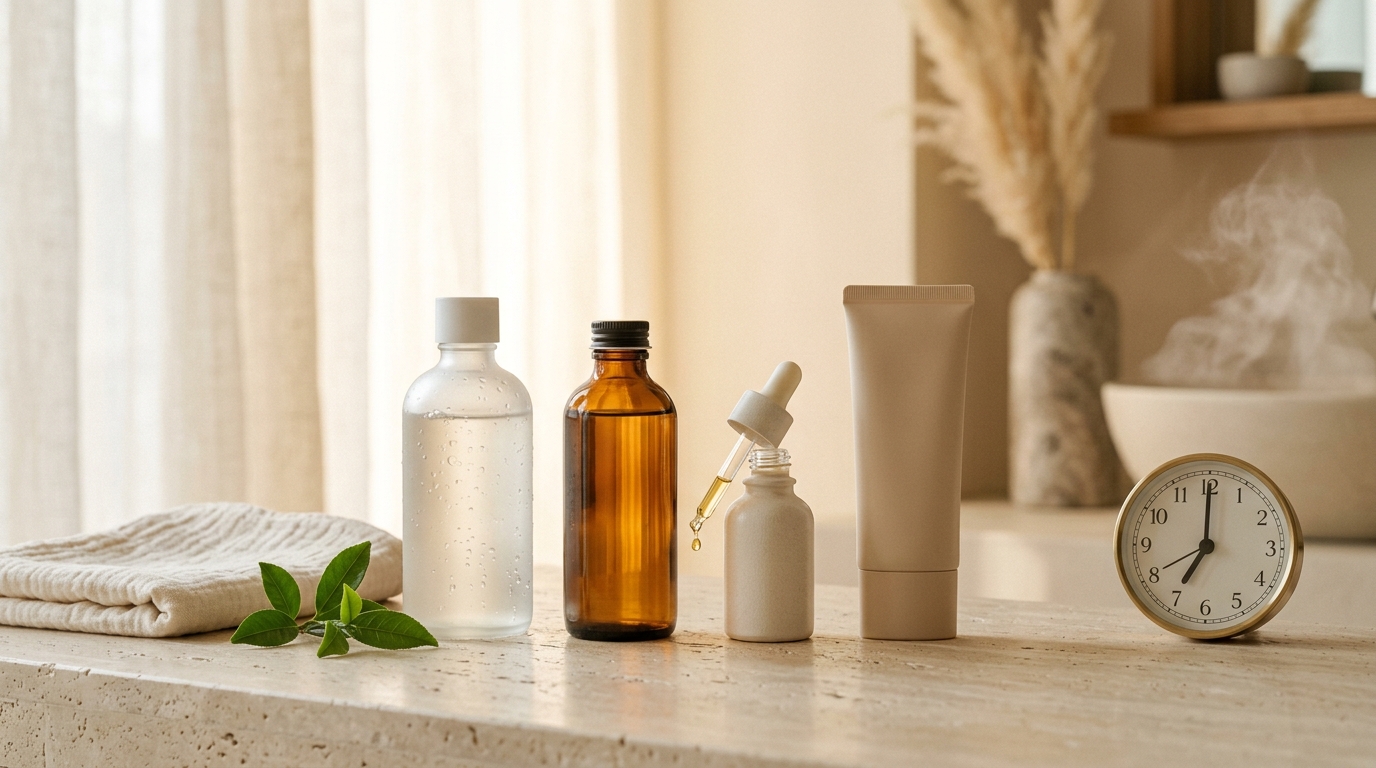
The best skincare routine isn't the most elaborate one, it's the one you'll actually do on a Tuesday night when you're exhausted. Here's how to build a 7-minute K-beauty routine that works harder than your abandoned 10-step one.
Quick Answer
Question: Can a 7-minute Korean skincare routine actually work as well as a full 10-step one?
Answer: Yes, and it works better for most people because you'll actually do it every single day. Consistency beats complexity every time. A well-built 4-step routine (cleanse, hydrate, treat, protect) with the right ingredients will outperform a 10-step routine you abandon after two weeks.
The Situation You're In
You've been here before. You watched the "full Korean 10-step routine" video, you bought the oil cleanser, the second cleanser, the toner, the essence, the serum, the ampoule, the sheet mask, the eye cream, the moisturizer, and the sleeping pack. Week one felt like self-care heaven. Week three, you were "too tired tonight." Week five, half the bottles were collecting dust on your shelf while you slept in your makeup.
Then you see a post from a 37-year-old who finally got consistent because her routine takes 7 minutes total, and something clicks. Maybe the problem was never your discipline. Maybe the problem was the routine.
Ugh, I know, the pressure to do "everything" in K-beauty is real, and it's the fastest way to do nothing. Let me show you how to build the short version that actually delivers.
Why 10-Step Routines Fail (And 7-Minute Ones Win)
Here's what nobody tells you when they're selling you the full lineup: the original "10-step routine" was never meant to be a daily thing. In Korea, that's closer to a weekend treatment cadence. Daily routines for most Korean women I know are more like 4–6 steps, done efficiently.
The reason your elaborate routine failed isn't that you're lazy, it's that skincare adherence drops off a cliff after about 8 minutes of active routine time. Dermatology research on treatment compliance shows the same thing across every condition: the longer the protocol, the lower the follow-through. Your skin doesn't care how many steps you intended to do. It cares what you actually applied, consistently, for 12 weeks.
A 7-minute routine wins because:
- It survives bad days. Tired? Hungover? Traveling? You can still do 7 minutes.
- Fewer products = fewer conflicts. Layering 9 actives is how you end up with a compromised barrier and mystery breakouts.
- Your wallet recovers. Four good products beat ten mediocre ones every time.
What Actually Works: The 7-Minute Routine, Built Right
Here's the structure. Four steps morning, four steps night, with some overlap. Each one earns its spot.
Step 1: A Cleanser That Doesn't Wreck Your Barrier (90 seconds)
Most routine failures start here. If your cleanser leaves your skin squeaky-tight, everything you put on after is damage control.
For mornings or sensitive skin, the Illiyoon Ceramide Ato Foam Cleanser (about $9.50 at Olive Young, 4.6 stars across roughly 5,800 reviews) cleans without that squeaky-tight feeling, and it is built around the same barrier lipids you are trying to protect rather than stripping them off. The thing to check on any cleanser is the surfactant: gentle ones like sodium cocoyl glutamate leave your barrier intact, while sulfates are where most routine failures start.
For evenings or anyone who wears makeup/SPF (which should be all of you), a gentle low-pH cleansing milk is the shortcut worth knowing, because it removes makeup AND cleanses in one step, so no double cleansing on a weeknight. Look for panthenol and madecassoside on the label, which means you are soothing your skin while you wash it rather than stripping it.
Browse more options on the cleansers page if neither of these fits your vibe.
Step 2: One Hydrating Toner (60 seconds)
This is where K-beauty separates from Western routines, and it's non-negotiable. Skip the "astringent" toners from the early 2000s, you want hydrating, pH-balancing, barrier-friendly.
The Klairs Supple Preparation Unscented Toner is the one I recommend most often because it does the job without drama. The top ingredients are sodium hyaluronate, centella asiatica, and panthenol, hydration, calming, barrier support, that's the entire pitch. No fragrance, no essential oils, no alcohol.
If your skin is actively irritated or you're recovering from over-exfoliation, swap in the Etude SoonJung pH 5.5 Relief Toner ($9.50, the Korea-vs-US price gap on this one is almost nothing, it's just genuinely cheap). It's the most minimal-ingredient toner I trust.
Pat two layers in with your hands. Done.
Step 3: One Active OR Moisturizer (2 minutes)
Here's where people go off the rails adding serums. Pick ONE active that addresses your actual concern:
- Breakouts / texture: a salicylic acid serum, 2–3x/week
- Dullness / pigmentation: niacinamide daily
- Aging / firmness: retinal or retinol at night only
- Redness / sensitivity: skip the active, go straight to a barrier cream
That's it. One. Not four. You can rotate over months, but you don't need them all on the same Tuesday.
Step 4: A Moisturizer That Seals Everything In (90 seconds)
The Illiyoon Ceramide Ato Concentrate Cream (about $17 at Olive Young, roughly 15,200 reviews) is the one we point people to when a barrier is wrecked or winter is coming. It is built around a pseudo-ceramide barrier lipid, the same class of molecule your skin uses to hold itself together, with no actives in it to complicate a recovery stretch. It is also the most-reviewed moisturizer in our catalog, which matters more than a high rating from a handful of people.
If you want lighter options, the moisturizers category has gel and lotion picks for oilier skin.
Morning-Only: SPF (90 seconds)
Not optional. Korean chemical sunscreens are generally lighter and more pleasant to wear than US formulas, which matters mostly because you will actually use one every day. One caveat if you buy in a US store, though: Korean sunscreens sold through US retail are frequently reformulated with FDA-approved filters and test measurably weaker than the Korean-market versions. Consumer Reports found Beauty of Joseon's SPF 36 came out around SPF 19 in the US, and Round Lab's SPF 46 near SPF 16. Even the Korean formulas tested under their SPF 50+ labels, so this is not "American bad, Korean good", and the gap is narrowing since the FDA approved bemotrizinol in 2026. Apply generously either way. See the sunscreens roundup.
The Real Math on 7 Minutes
Morning: cleanser (90s) → toner (60s) → niacinamide or moisturizer (90s) → SPF (90s) = 5.5 minutes
Night: cleansing milk (90s) → toner (60s) → active OR cream (2m) → occlusive cream if needed (90s) = 7 minutes
That's it. That's the whole thing.
Key Takeaways
- Consistency > complexity. A 7-minute routine done 7 days a week crushes a 15-minute routine done 3 days a week.
- Four steps, four jobs: clean, hydrate, treat, protect.
- One active at a time. Stacking serums is how most people wreck their barriers.
- Barrier-first ingredients (ceramides, panthenol, centella, hyaluronic acid) do more for skin than any trendy active.
- Expensive ≠ better. The $9.50 SoonJung toner outperforms $40 toners from luxury brands.
Frequently Asked Questions
Is a 7-minute routine enough for anti-aging?
Yes, if it includes SPF daily and a retinoid 3–5 nights a week. Those two things deliver 80% of topical anti-aging results. Everything else is a supporting cast. You don't need seven ampoules.
What if I have multiple skin concerns?
Rotate actives by night, not by layering. Monday/Wednesday/Friday: retinol. Tuesday/Thursday: exfoliating acid. Weekend: barrier repair only. This prevents the inflammation cascade that happens when you layer too many actives at once.
Can I skip toner?
You can, but I'd push back. Korean hydrating toners aren't the stripping astringents you're thinking of, they're a hydration primer that makes every following step absorb better. That said, if you're going from 10 steps to 4, cutting toner is the least harmful shortcut.
How long before I see results?
Skin cell turnover is roughly 28 days, and most actives need 8–12 weeks to show their real work. Give your 7-minute routine a full 90 days before judging it. Taking weekly photos in the same lighting helps, you'll miss gradual changes in the mirror.
What if I'm not sure which products fit my skin type?
This is the part where it helps to have someone look at your specific situation. There's a free AI advisor on the Seoul Sister homepage that'll give you product recommendations based on your skin type and concerns, useful if you're staring at the ingredients encyclopedia trying to self-diagnose.
The Bottom Line
The woman who posted about her 7-minute routine didn't find a secret. She found the actual answer: the routine you do every day beats the routine you do sometimes. Pick four products that earn their place, learn what's in them, and stop letting Instagram convince you that more steps equal better skin.
If you want to go deeper on any ingredient before you buy, every product I mentioned here has its actives linked to full breakdowns, start with ceramide, niacinamide, and centella asiatica, and you'll understand 90% of Korean skincare in an afternoon.
Your routine doesn't need to be impressive. It needs to be done.