Best Korean Face Mask for Your Skin Type: 8 Picks by Concern
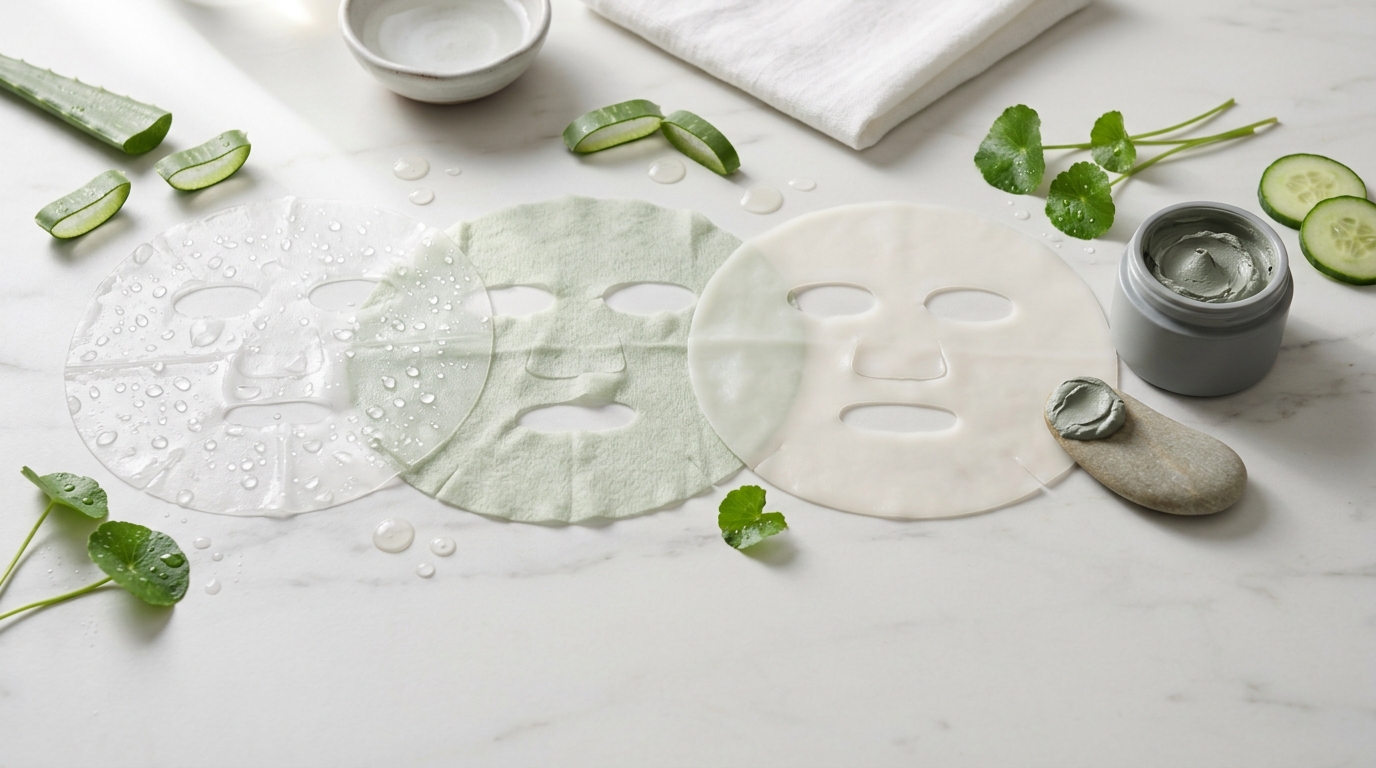
Eight Korean masks matched to real skin concerns, each justified by what's actually on the ingredient list, not the front of the box. Dry, sensitive, oily, and dull-looking skin each get two picks, with the fragrance figure you need to know before you buy.
Quick Answer
Question: How do I pick the best Korean face mask for my skin type?
Answer: Match the mask to your concern, then check the ingredient list, not the front label. Dry skin wants a water-gel sheet or overnight mask heavy on hyaluronic acid and glycerin; sensitive skin wants a fragrance-free cica sheet; oily or congested pores want a kaolin clay wash-off; dull skin wants hydration plus a gentle polish. A mask is a short boost on top of your routine, never a replacement for moisturizer or sunscreen.
The Situation You're In
You're standing in the Olive Young aisle (or scrolling a product page at midnight) holding a mask that says "calming" and "cica" in soft green lettering, and you have no idea whether it'll actually calm your skin or set your cheeks on fire. The front promises one thing. The back is half in Korean. And you've already bought one "soothing" mask this year that stung like crazy the second you unfolded it.
Here's a two-minute thing you can do before you buy anything: pull up the ingredient list on whatever mask is already sitting in your cabinet and scan it for "fragrance," "parfum," or any of the common fragrance allergens like limonene, linalool, or citral. If you want to know why that matters for reactive skin, our fragrance ingredient page breaks it down. That one habit, reading the list instead of the front, is most of what separates a mask that works from one that wastes your money.
Why This Happens
Korean mask labels are genuinely hard to read when you can't read Korean, and the marketing leans on vibe words that aren't regulated. "Calming," "glow," and "cica" on the front tell you what the brand wants you to feel, not what's in the bottle. In Seoul Sister's own catalog, checked October 2026, of 777 verified face-mask listings with an ingredient list, 33% list "fragrance" or "parfum" outright. Count essential oils and fragrance allergens too, and that jumps to 62%. So a mask can say "calming" on the front and still carry the exact thing that irritates sensitive skin.
The other reason picking feels hard: most sheet masks are more similar than they look. Of the sheet masks in that catalog, 78% list water as the first ingredient, which means the serum soaked into the sheet is mostly water plus humectants. The stuff that actually makes one mask different from another sits a few lines down the list. That's where you find the centella, the ceramides, the niacinamide, the good hyaluronic acid. If you only read the first line, every mask looks the same.
And about three in four of those listings (575 of 777) are single-use sheet or gel masks, so that's what most people are choosing between. One quick frame before the picks: there are three mask types here. Single-use sheet masks you leave on for a bit, then pat the leftover essence in. Overnight or sleeping masks go on as your last step at night and stay on. Wash-off clay or scrub masks get rinsed off after a few minutes. If you're not sure what your skin type even is, start with how to figure out your skin type for Korean skincare and come back.
What Actually Works
The best Korean face mask is the one matched to your actual concern, with an ingredient list that backs up the claim on the front. Here are eight picks across four concerns, two each, with the ingredients that justify them. Most people have two of these at once (oily T-zone, reactive cheeks), so it's fine to own more than one.
Dry or dehydrated: load up on humectants
For dry or dehydrated skin, you want a sheet or overnight mask built around glycerin and hyaluronic acid, not a clay that pulls moisture out. The Round Lab 1025 Dokdo Hydrating Water Gel Mask Sheet is the one I'd grab here. It leads with glycerin and sea water and then lists eight forms of hyaluronic acid on one label, including sodium hyaluronate, hydrolyzed hyaluronic acid, and sodium hyaluronate crosspolymer, plus panthenol, betaine, and allantoin. No fragrance on the list. It's a single-use sheet, so leave it on, then pat in what's left. (see the current price)
If your skin drinks everything overnight, the COSRX Ultimate Nourishing Rice Overnight Spa Mask is a leave-on option. Rice (Oryza Sativa) extract is the first ingredient, followed by glycerin, sunflower seed oil, betaine, niacinamide, dimethicone, and palm oils, so it's richer than a watery sheet. No fragrance on the list. Use it as your last step at night and leave it on while you sleep. (see the current price)
Sensitive or redness-prone: read the list for fragrance first
For sensitive skin, the single most useful thing you can do is check for fragrance, because 62% of masks in Seoul Sister's catalog carry fragrance or essential oils once you count allergens, and "cica" on the front does not mean unscented. Both of these picks skip fragrance.
The Cell Fusion C Cica Cooling Mask Sheet puts centella asiatica extract as its second ingredient, and stacks centella leaf, root, and flower extracts plus madecassoside, asiaticoside, sodium hyaluronate, panthenol, and allantoin. Centella is the ingredient most associated with calming reactive skin in K-beauty, and there's a lot of it here. One honest note: the "cooling" doesn't come from the plant, it comes from methyl diisopropyl propionamide, a synthetic cooling agent on the list. No fragrance. (see the current price)
The ma:nyo Bifida Biome Ampoule Mask Sheet Intensive Recovery leans on barrier-support ingredients: bifida ferment lysate at 10,000ppm (that's 1%), niacinamide, ceramide NP, panthenol, madecassoside, hyaluronic acid, and licorice root extract. No fragrance. Worth knowing it also lists witch hazel water, which a few very reactive people prefer to avoid, so scan for it if that's you. (see the current price) If your skin feels tight, stingy, or raw lately, read how to tell if your skin barrier is damaged before you mask at all.
Oily or congested pores: a kaolin clay you rinse off
For oily skin or congested pores, a wash-off kaolin clay mask is the move, used once or twice a week, not daily. The SKIN1004 Madagascar Centella Poremizing Quick Clay Stick Mask is a twist-up stick built on kaolin at 18%, bentonite, illite, montmorillonite, and calamine, with centella asiatica extract at 4.9% to keep it from feeling harsh. The stick holds its shape thanks to sodium stearate, a soap-type gelling agent, and it's tinted with titanium dioxide and iron oxide. Rinse it off after a few minutes. No fragrance. (see the current price)
If you'd rather scoop from a jar, the Isntree Mugwort Calming Clay Mask pairs kaolin at 17.4% and bentonite at 6% with mugwort (Artemisia Princeps) extract at 5%, plus panthenol, allantoin, and beta-glucan to soften the experience. No fragrance or essential oils on the list. It does list red bean seed powder (a mild particle) and cinnamon bark extract, so if cinnamon extract is a known trigger for you, that's your heads-up. Wash-off. (see the current price)
Dull-looking: hydration plus a gentle polish
For dull-looking skin, the honest fix is hydration plus an occasional gentle polish, not a one-mask "brightening" miracle. The APLB Glutathione Niacinamide Sheet Mask is worth understanding clearly. Its real content is centella asiatica extract at 13.5%, with squalane, cholesterol, beta-glucan, and sodium hyaluronate. The niacinamide and glutathione in the name? Each is at 1,000ppm, which is 0.1%. So the name promises more than the list delivers. Treat it as a well-built hydrating centella sheet, not a spot fader. No fragrance (it lists tea tree leaf extract, not tea tree oil). (see the current price)
For the gentle polish, the Beauty of Joseon Ground Rice and Honey Glow Mask is a wash-off built on kaolin, honey, rice hull powder, rice bran, and rice extracts. Rice hull powder is a gritty scrub particle, so skip this one on irritated or broken skin and use a light hand everywhere else. No fragrance, though it does list menthyl lactate, a cooling agent. Wash-off. (see the current price)
Here's the quick comparison:
| Product | Skin concern | Type | Fragrance or essential oils on the list | Pack |
|---|---|---|---|---|
| Round Lab 1025 Dokdo Hydrating Water Gel | Dry / dehydrated | Sheet | No | 10 sheets |
| COSRX Ultimate Nourishing Rice Overnight | Dry / dehydrated | Overnight (leave on) | No | 60ml |
| Cell Fusion C Cica Cooling | Sensitive / redness | Sheet | No (has a cooling agent) | 1 sheet |
| ma:nyo Bifida Biome Ampoule | Sensitive / redness | Sheet | No | 1 sheet |
| SKIN1004 Madagascar Centella Poremizing Clay Stick | Oily / congested | Wash-off clay | No | 27g stick |
| Isntree Mugwort Calming Clay | Oily / congested | Wash-off clay | No | 100ml |
| APLB Glutathione Niacinamide | Dull | Sheet | No | 10 sheets |
| Beauty of Joseon Ground Rice and Honey Glow | Dull | Wash-off | No (has a cooling agent) | 150ml |
Most people fit two of these boxes at once. If you want to talk through which mask fits your specific skin and how often to use it, tap Ask Yuri on this page, which opens a free chat, no account needed. Yuri is Seoul Sister's AI advisor.
Frequently Asked Questions
How often should I use a Korean face mask?
A mask is an occasional boost, not a daily essential, so most people do fine with a sheet mask once or twice a week and a wash-off clay mask once or twice a week at most. Clay masks on oily skin shouldn't be stacked back to back, and you shouldn't use any mask on skin that's broken, burning, or actively irritated. If a rash is spreading or your skin is burning, see a doctor rather than reaching for a mask.
Does "cica" or "calming" on the front mean a mask is fragrance-free?
No. In Seoul Sister's catalog, 33% of masks list fragrance or parfum outright, and that climbs to 62% once you count essential oils and fragrance allergens like limonene, linalool, and citral. The word on the front is marketing, so the only way to know is to read the ingredient list and scan for those terms yourself.
Can a face mask replace my moisturizer or sunscreen?
No, a mask is a short, occasional top-up on an existing routine, not a replacement for either. Sheet and overnight masks deliver a burst of humectants, but you still want your regular moisturizer to seal that in and daily sunscreen for actual protection. If you need a daily moisturizer to pair with these, start with our 8 Korean moisturizer picks by skin type.
Why is water the first ingredient on most sheet masks?
Because 78% of the sheet masks in Seoul Sister's catalog list water first, which just means the serum is mostly water plus humectants. That's normal and not a red flag. The ingredients that make one mask meaningfully different, like centella, ceramides, or hyaluronic acid, sit a few lines below the first, so that's where to look when you compare two masks.
Are sheet masks or clay masks better for oily skin?
For oily or congested pores, a wash-off kaolin clay mask like the SKIN1004 Madagascar Centella clay stick or the Isntree Mugwort Calming Clay is usually the better fit, used once or twice a week. Clay absorbs excess surface oil; a hydrating sheet mask doesn't do that job. That said, oily skin that's also dehydrated can use both on different days.
The Bottom Line
The best Korean face mask for your skin type comes down to matching the format to your concern and then reading the list to confirm the front label is telling the truth. Dry skin wants humectant-heavy sheets or an overnight mask, sensitive skin wants a fragrance-free cica or barrier sheet, oily skin wants a kaolin clay you rinse off, and dull skin wants hydration plus a light polish. Across all of them, the single highest-value habit is scanning for fragrance before you buy, because "calming" on the box doesn't mean unscented.
If you want to see more options or compare formats side by side, our best Korean masks page pulls from the full catalog, and you can dig into any single ingredient on the ingredient encyclopedia. Pick the one mask that fits the concern bothering you most this week, use it once, and see how your skin feels before you build a whole drawer of them.